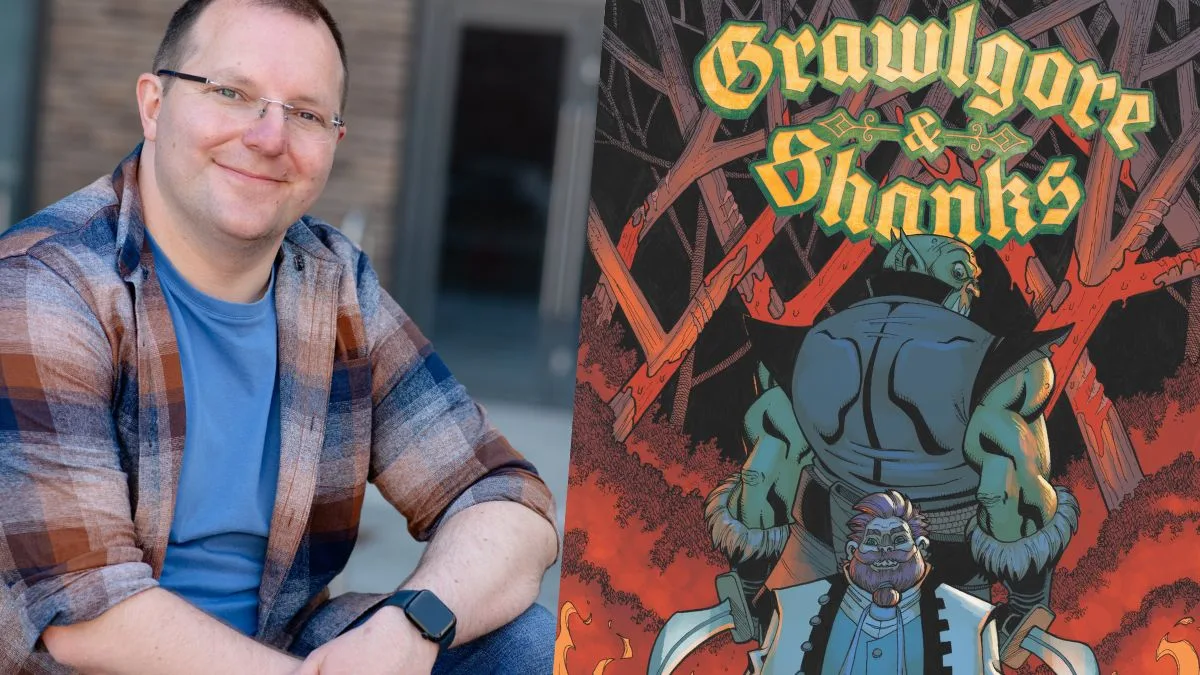
There is a particular kind of horror that does not announce itself with spectacle. It lingers instead in atmosphere, in spaces that feel lived-in and neglected, in characters whose interior lives carry as much weight as any external threat they face. It is in this quieter register that John Lees has built his career.
Over more than a decade of creator-owned and independent work, Lees has developed a body of comics that prioritises restraint over excess, character over shock, and place over abstraction. His stories are not interested in genre as performance. They use horror, fantasy, and dark humour as lenses through which to examine grief, community, class, and the slow pressure of environments on the people who inhabit them.
That emphasis on restraint is not incidental. It is rooted in a deep appreciation for the formal discipline of the medium itself. As Lees explains, “I actually really enjoy the restraint of it. How you only have so many pages per issue, so many panels per page, so many words per panel. How you’re trying to create a sense of movement in a still image, or a sense of sound in a silent medium.” For him, limitation is not something to be overcome, but something that sharpens intention.
What distinguishes Lees’ work, then, is not simply its consistency, but its patience. His comics trust readers to sit with ambiguity, to remain in the build-up rather than rush toward release. In doing so, they reflect a broader creative philosophy rooted in discipline, collaboration, and a belief that comics, as a still-evolving art form, can continue to find new emotional and formal ground.
This feature looks at how that philosophy emerged, how it has been sustained, and how it sits within the wider Scottish comics landscape today.
Beginnings: From Reader to Creator
For John Lees, the move into comics did not arrive as a sudden change of direction so much as a convergence. He had always wanted to be a writer, and comics had long been part of what he read and enjoyed. The moment the two strands came together was practical rather than romantic. In 2008, an artist friend approached him about writing a comic script, prompting Lees to research the form and its mechanics.
“That led to me doing some research on how to write comic scripts, and I quickly fell in love with the discipline,” he recalls. The fixed number of pages, panels, and words appealed to him, as did the challenge of creating movement in still images and sound in a silent medium. Comics, he realised, were both historically rich and still young enough to feel open to experimentation.
His first completed script became The Standard, a series about an elderly former superhero drawn back into action by the murder of his former sidekick. When the project stalled, the script found a second life through The Proving Grounds, an online forum where editor Steven Forbes publicly reviewed submissions with a reputation for blunt, often unforgiving feedback. Lees submitted the script expecting critique and instruction. Instead, he received encouragement. Forbes noted that it was the first submission he had continued reading beyond the excerpt simply because he wanted to know what happened next, later offering to edit the series if Lees wanted to take it further.
What followed was a years-long education in making comics. Bringing The Standard from script to finished book meant learning not only how to write effectively for the medium, but how to work with artists, manage a project, and see a story through to print. The milestones accumulated slowly but meaningfully. Receiving the first pages of art. Holding printed copies of the book. Reading the first review. Selling the comic at a convention. Each step reinforced the sense that this was not an abstract ambition, but a practice he wanted to commit to long-term. As Lees puts it, “I’d caught the bug.”
Finding a Voice: Horror as Human Story
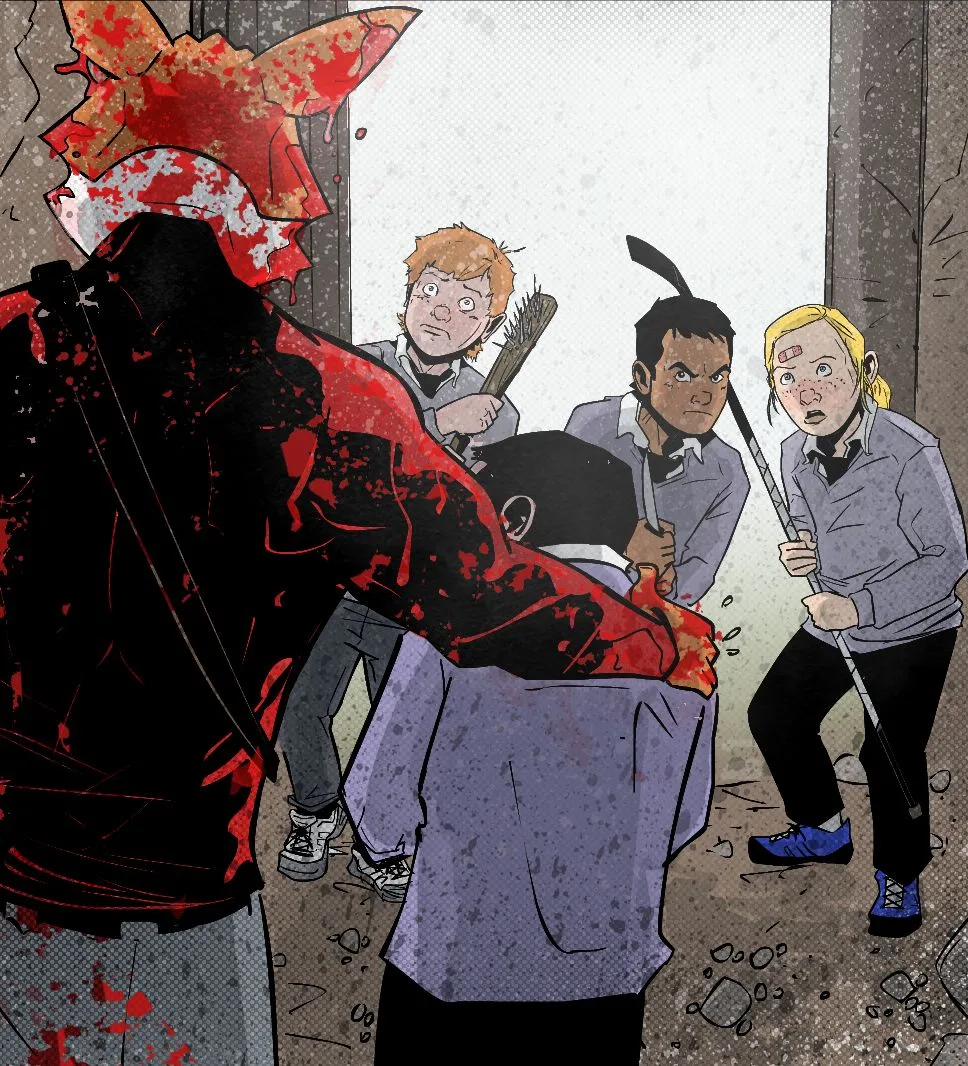
Although John Lees is now best known for horror, his creative priorities were never genre-led. At the centre of his work is a belief that the strongest stories, regardless of form, begin with character. As Lees puts it, “The best stories in every genre are rooted in character. Whether it’s horror or action or comedy or romance, if it builds out of characters you care about, the audience is going to be more invested.”
A formative moment in clarifying that approach came not through horror, but through a project that never reached publication. Deep-Ender, a swimming-based sports comedy, pushed Lees far outside his comfort zone. Early drafts struggled, particularly with humour, until he realised that the issue was not the absence of jokes, but the thinness of the characters. “I eventually realised the humour would come not from one-liners,” he explains, “but from making the characters feel more fully realised and relatable.”
Although Deep-Ender never made it beyond its initial stages, its influence endured. The lessons Lees took from it travelled back with him into his horror work. The stories became warmer, more character-driven, and often funnier in unexpected ways. Horror, in this context, was not a rejection of humanity but an extension of it.
That same thinking informs Lees’ approach to atmosphere and restraint. With horror in particular, he is wary of rushing toward revelation. “The strongest horror comes from the unknown,” he notes. “Once everything is out in the open, there’s nowhere to go from there. Your story can’t be all climax.” By lingering in that unsettled space, his work creates room for dread, empathy, and emotional complexity to coexist.
Place as Character
In John Lees’ work, setting is never incidental. Estates, hotels, towns, and landscapes do not simply host the story. They shape it. Place exerts pressure on characters, quietly informing their choices and limiting their options.
Lees has spoken about encountering the idea that stories deepen in stages, moving from plot, to character, to setting. The most immersive stories, he suggests, emerge when all three are fully realised. That philosophy has become central to how he approaches comics. Locations in his work are given texture and personality, not as an exercise in worldbuilding, but as a way of grounding social and emotional realities in something tangible.
This approach carries particular weight in his decision to set many of his stories explicitly in Scotland. Rather than treating location as interchangeable, Lees makes a conscious effort to render Scottish places as specific, lived-in environments. In his view, this is not an act of branding but of expansion. “I think every time we do this, we are making Scotland more visible, and expanding the types of stories that are being told in Scotland,” he says.
For readers outside Scotland, these settings can subtly shift perception. For readers within Scotland, the effect can be more immediate. Recognition. Validation. The quiet impact of seeing a version of your own world reflected back on the page, treated with seriousness rather than novelty.
The social dimensions of place are never overstated in Lees’ work, but they are always present. Marginalisation, class pressure, and isolation seep into the story through environment rather than exposition. Housing estates decay. Buildings remember what has happened inside them. Communities carry scars that individual characters cannot entirely escape.
Building a Career Outside the Centre
A career built largely through creator-owned and independent work carries a particular emotional texture. For John Lees, that path has offered freedom and fulfilment alongside a persistent undercurrent of uncertainty. “That career path has given me a lot of stress and anxiety, for starters,” he says, with characteristic frankness.
When Lees thinks back to his ambitions while writing his first scripts in 2008, the scale was modest. There was no fixed vision of acclaim or expansion, only a quiet hope. “Back when I first started, my pipe dream was that one day I’d have a shelf of books with my name on them,” he reflects. “And now I have that.” What was once abstract is now tangible. Comics written, published, and shared. Readers reaching out to say that a story resonated, that it spoke to something personal, that it mattered.
That exchange between creator and reader sits at the centre of why the work endures. Writing stories that belong to you and the people you collaborate with carries a different weight. Characters and worlds that did not exist until they were made together. Even as Lees acknowledges the appeal of licensed work and the opportunities it can offer, there is a particular potency in creator-owned storytelling.
Sustaining that kind of career, however, has grown increasingly difficult. Lees describes an industry that feels as though it is contracting. Opportunities narrow. Publishers grow more cautious. Runs become shorter. Alongside this, the informal infrastructure that once helped sustain independent comics culture has eroded.
Perhaps the most difficult lesson has been the volatility of it all. The realisation that there is no stable model for success. That paths which carried creators toward sustainable careers even five or ten years ago can vanish without warning.
Scotland and the Domestic Scene
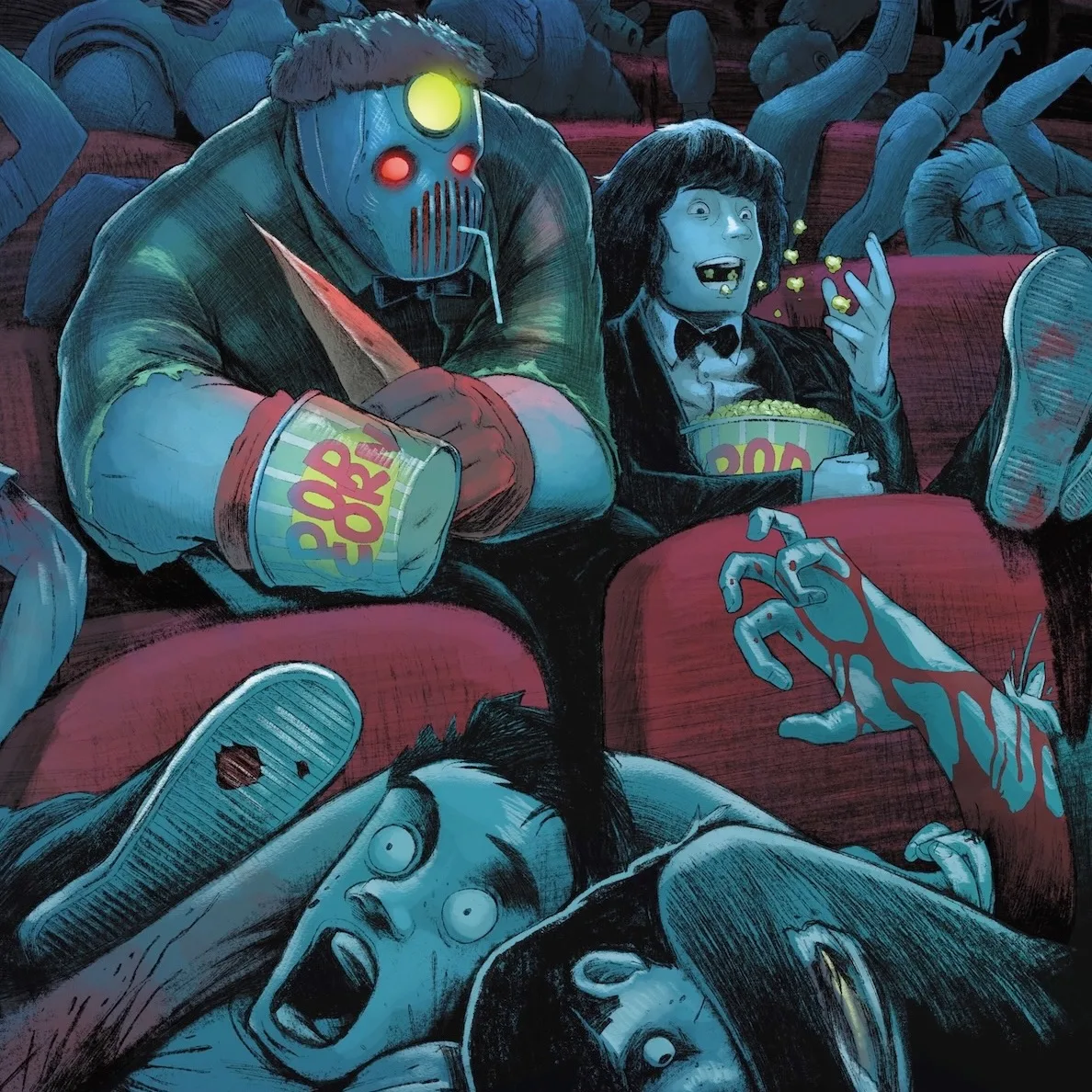
John Lees’ perspective on the Scottish comics scene is shaped by time as much as participation. He has been present long enough to see it form, flourish, contract, and begin to reconfigure itself again.
When Lees first began making comics, the infrastructure was sparse. Glasgow comic shops did not carry dedicated small press sections, and the idea of a visible domestic scene felt distant. His emergence coincided with a wider moment of collective momentum. He co-founded the Glasgow League of Writers during this period, alongside the rise of other collectives and the launch of Glasgow Comic Con.
That period did not sustain itself indefinitely. As the wider comics industry tightened, the effects were felt locally. Burnout took its toll. “For a while, it felt like Scottish comics needed a refresh, like it needed a new shot in the arm rather than trailing on the echoes of that early 2010s boom,” Lees observes.
He believes that refresh is now underway. New creators are emerging with different perspectives and energies, and events like Sequential Scotland have begun to feel like markers of that shift.
When asked whether there is something distinctly Scottish in the way comics are made here, Lees is cautious. Creation itself is universal, he suggests, but no work is made in isolation from the person making it. Cultural identity emerges not as a label, but as a trace.
Industry Perspective
From John Lees’ vantage point, one of the most persistent distortions within the comics industry is where attention is directed. “The bulk of the comics industry is independent or creator-owned work,” he says, yet coverage and shelf space continue to orbit a small number of dominant publishers.
This imbalance has tangible consequences. Work produced outside the centre can struggle to reach readers, regardless of quality or ambition. Lees does not frame this as a moral failing, but as a structural habit that has hardened over time.
The instability of the industry feeds into a central tension for independent creators. The pressure to remain visible and productive sits in constant friction with the slower, more demanding work of making stories that feel honest. For Lees, sustainability must be emotional as well as economic.
Rather than positioning himself against the industry, his perspective suggests a quieter form of resistance. One rooted in consistency, adaptability, and alignment between values and practice.
Looking Forward
When John Lees talks about the future, he does so without grand declarations or fixed endpoints. What continues to drive him creatively is character. “If I don’t have characters rattling around in my head, pestering me to get them down on the page, then I’ll know I’m done,” he says.
That perspective also shapes how he defines success at this stage of his career. A good year is practical rather than aspirational. A comic released into shops. Another project underway. Further ideas in development that generate excitement rather than obligation.
After years of navigating shifting industry conditions, Lees’ focus has narrowed rather than expanded. The aim is not to do everything, but to keep doing the work that feels meaningful.
Closing Note
For readers encountering John Lees’ work for the first time, what they are likely to discover is not a single defining story, but a body of work shaped by accumulation. Comics made over time, with care, through collaboration, and with a clear understanding of what the medium can and cannot do.
Within the context of Scottish comics, Lees’ career stands as a reminder that longevity itself is an achievement. Visibility does not always arrive through momentum or scale, but through persistence and adaptability.
There is no sense of arrival here, and no need for one. As long as there are characters worth caring about, stories will follow. And as long as those stories are being told with honesty and restraint, the work continues, patiently, on its own terms.
Read our full interview with John Lees here.