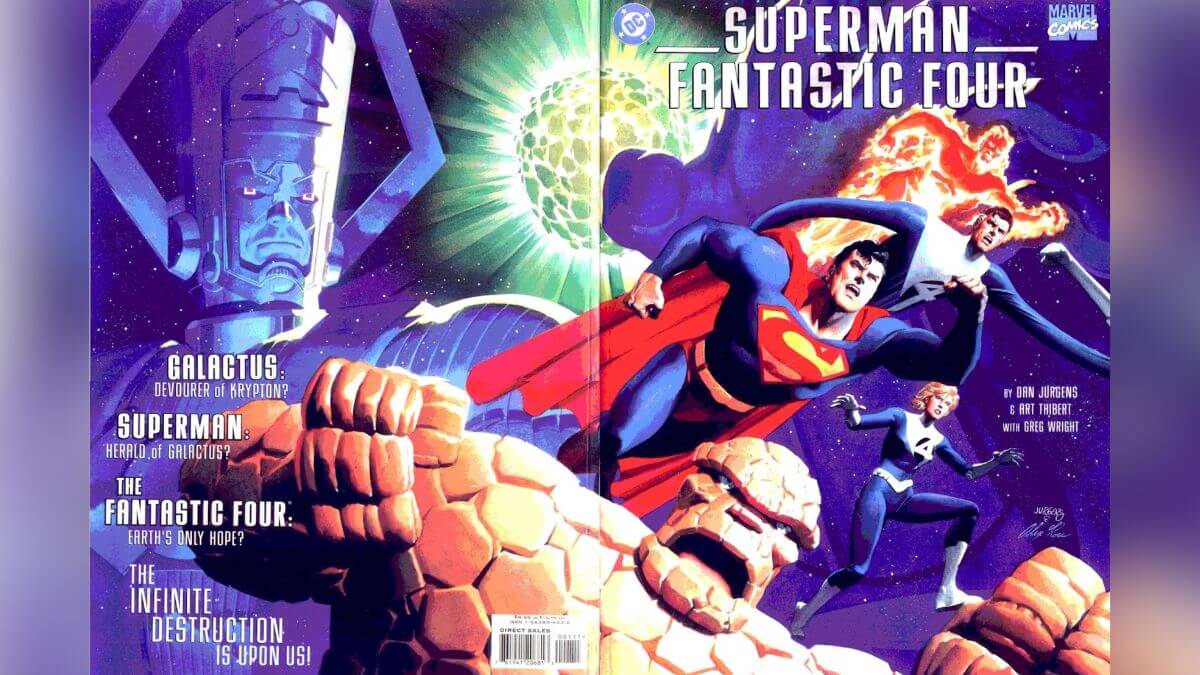
Comics Bulletin is partying like it’s 1999 in revisiting the intercompany crossover featuring the Man of Steel and Marvel‘s First Family.
There are few writers more synonymous with a particular superhero character than Dan Jurgens with Superman. From The Death of Superman to DC Rebirth and beyond, Jurgens has played a critical role throughout the past several decades in shaping the modern Superman. But with this one-shot, he proves equally adept at handling the family dynamics of the Fantastic Four, both in terms of writing and art. While this is by no means a perfect comic, it is enjoyable and clears the low bar of 1990s superhero comics to be at the very least good.
Having been part of the creative team behind the gimmicky DC vs. Marvel, Jurgens remembers that the character/plot device Access exists and rightfully uses him to allow this intercompany crossover to happen. Granted, Access is only given a fleeting mention by way of dialogue and any multiversal shenanigans occur off-panel, but their inclusion can be appreciated all the same. And while this brief description may appear flippant to readers, it is only to demonstrate the clunkiness of the initial storytelling and how beholden Jurgens is to the established canon of these universes interacting with one another. Similar contrivances can be found in the lauded JLA/Avengers, but that series comprised of four oversized issues and therefore had the room to breathe. Being a one-shot Superman/Fantastic Four does not have the same luxury and therefore these mechanicians take up time that could be better served.
Once the characters are on the same world, there is very little to complain about other than minor nits. As alluded to, Jurgens nails the dynamic between the Fantastic Four (plus little Franklin Richards). Ben and Johnny rib each other whenever they can, Reed is laser focused on the scientific breakthrough at hand, and Sue ends up having to manage the competing egos of the group. It is good to see Jurgens has a solid grasp on the group dynamics, as he will soon be shaking it up in a major way.
Not long after Superman meets up with the Fantastic Four does all hell break loose. The Man of Steel soon becomes the new herald of Galactus, and Reed Richards is taken prisoner by the planet-eater. Also, Cyborg Superman shows up and forms an uneasy alliance with the Fantastic Three, where Sue has taken over as the de facto leader. From here, there are great little moments that Jurgens sprinkles in for the readers’ enjoyment. Cyborg Superman recounts his origin as Hank Henshaw and how his doomed space flight mirrors that which gave the Fantastic Four their abilities. Superman, though the herald of Galactus, only provides his master lifeless planets to be consumed and therefore putting up a subconscious fight. It is this – the valuing of all life (take notes Snyder Bros) – that ultimately causes Superman to break free of Galactus’ control and turn the tables.
For being a twenty-six year old story, Superman/Fantastic Four holds up fairly well. As a matter of preference, DC’s 1990s work tends to hold up better than most of their contemporaries. Jurgens’ and Art Thibert’s art and the coloring by Gregory Wright is definitely dated, but still very good. Galactus looks phenomenal, as do most of the issue’s main setpieces. By contrast, young Franklin Richards suffers from looking like a bobblehead in some panels, which tends to be a common issue when mainstream comic artists are required to draw children. That said, it is a minor quibble in what is by and large a great looking book. And if you’re able to grab it in the original tabloid size, even better.
Superman/Fantastic Four is an excellent crossover and a worthy investment in one’s time. For longtime fans of Superman, the Fantastic Four, or both, this one-shot lets the characters shine brightly while introducing new, engaging character dynamics. And for those with a curiosity due to the new movies in theaters, this acts as a perfect companion piece for those looking to get more of a “superfantastic” fix.