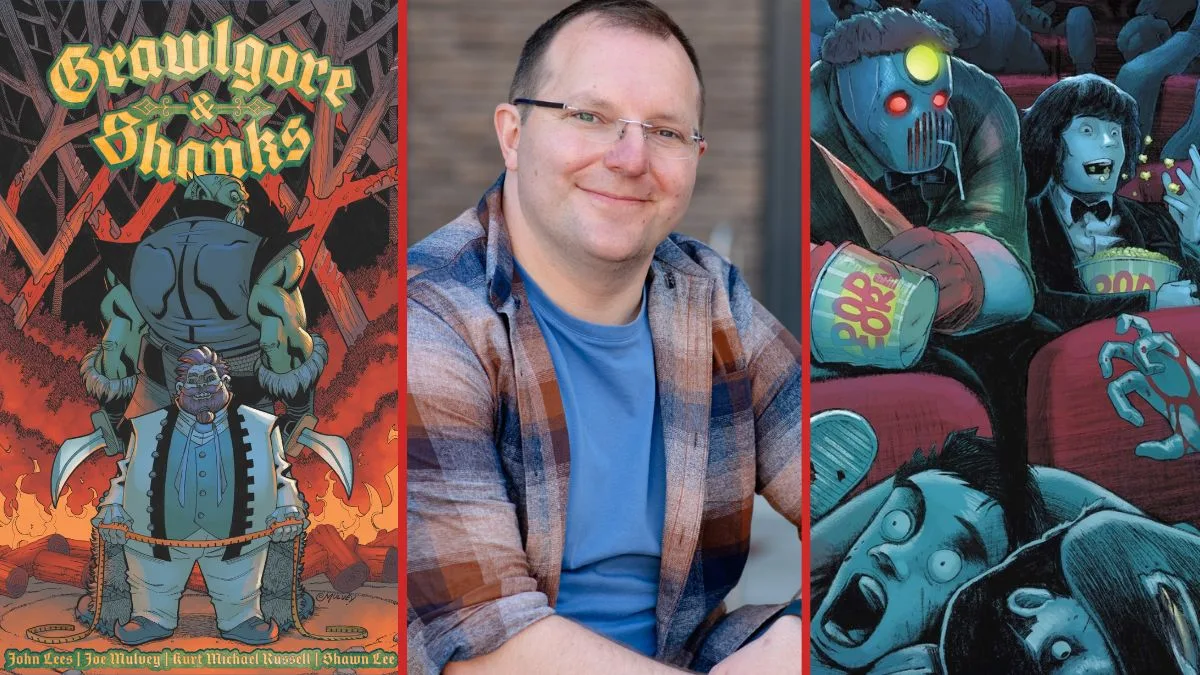
We recently sat down with Scottish comic book creator John Lees to discuss his career, the comics medium, and so much more. We’ve compiled the complete interview below.
This article is a companion to our feature on John Lees, titled: Horror, Place, and the Quiet Longevity of Scottish Comics. You can read that feature here. But if you want to check out our entire interview, you can do so below!
Do you remember when comics shifted from something you enjoyed to something you knew you wanted to make?
I’ve always wanted to be a writer, and I’ve long enjoyed comics, but the specific point when I put the two together and knew I wanted to write comics was back around 2008 when an artist friend of mine approached me about writing a comic script for them. That led to me doing some research on how to write comic scripts, and I quickly fell in love with the discipline. I actually really enjoy the restraint of it. How you only have so many pages per issue, so many panels per page, so many words per panel. How you’re trying to create a sense of movement in a still image, or a sense of sound in a silent medium. I was intrigued by the idea that comics, despite its rich history, is still a relatively nascent art form, and there was perhaps the possibility of doing new and exciting things in the medium. My artist friend and I never did end up working together on a comic, but by that point I’d caught the bug.
What did your earliest steps into making comics look like, and what from that period still shapes how you work today?
The first ever comic script I wrote was issue #1 of The Standard, my debut comic series about an elderly former superhero who comes out of retirement to solve his onetime sidekick’s murder. I’d written this script for my friend, and then when that didn’t go ahead, the script was kinda just sitting there until I found this online resource called The Proving Grounds, where editor Steven Forbes would review scripts and give (often scathing!) feedback. I thought it would be an educational experience to find out how I could improve as a writer, so I submitted my script, and when it was my turn on the chopping block, it actually got a positive review from Steve! He went on to say that it was the only script submitted for The Proving Grounds up to that point where he kept on reading after the excerpt for his column because he wanted to know what happened next. He later reached out to me and offered to be the editor on The Standard if I wanted to proceed with actually getting it made. Taking The Standard from script to finished comic was a challenging process that ended up taking several years, but by the end of the final issue, I felt like I’d figured out how to script a comic, and I’d also received a crash course on working with a creative team and managing a project. Steven Forbes was a major figure in my early development as a comics writer. His guidance on how to format a comic script included lessons that I still apply to my writing to this day.
Was there a particular project or collaboration that made the work start to feel real for you?
It felt real to me right from that first project, The Standard. Right from when I was making that book, I thought, “This is what I want to do with my life.” And the whole process took me through stages of it feeling more and more real. The first time I got pages of art in from the artist, Jonathan Rector. The first time I received printed copies of the finished book and could hold it as a physical artefact. My first time reading a review of my comic. My first time selling it at a con.
Craft, Voice, and Storytelling
Your work often blends psychological horror with deeply human, grounded emotion. What draws you to that space creatively?
For me, the best stories in every genre are rooted in character. Whether it’s horror or action or comedy or romance, if it builds out of characters you care about with relatable plights, then the audience is going to be more invested in the genre mechanics, i.e. the scares are going to be more tense and frightening because the reader cares about the fate of the characters. I feel a significant work for my development was Deep-Ender, a swimming-based sports comedy that never got picked up by a publisher or widely released, or even produced beyond the first couple of issues, but which I scripted in full. That was really outside my wheelhouse when I first wrote it, and I found it a struggle at first trying to get a handle on how to make it funny, until I eventually realised the humour would come not from one-liners, but from making the characters feel more fully realised and relatable, so that the situations they got themselves into would then become funnier because they felt authentic. And while Deep-Ender never got over the line, I feel I then carried Deep-Ender with me back into the horror projects I returned to afterwards. They became funnier, and more character-focused, and tended to have this big heart at their emotional core.
Your stories tend to favour atmosphere and restraint over spectacle. How conscious is that choice when you’re writing?
I don’t know about that, I think some of the spectacle in books like Sink can get pretty outrageous! But generally speaking, I get where you’re coming from. With something like horror, the build-up is always where tension and dread are at their highest. Once the monster gets revealed, or we’re in the final showdown between the Slasher and the Final Girl, there’s almost this exhalation of relief, a release of tension, because everything is now out in the open and we know what we’re dealing with. The strongest horror comes from the unknown. And so, as a writer, I think it’s good to stay in that stage for as long as you can, holding off on the full reveal. Because once you go all-out with the spectacle and your horror is out in the open spilling blood and guts left and right, there’s nowhere to go from there. Your story can’t be all climax.
Place often feels like a character in your work. What does setting allow you to explore that character alone cannot?
I am butchering this in the paraphrasing, I’m sure, especially since I can no longer recall the source, but I remember reading once about the three stages of story depth. The first stage is having a well-developed plot. The second stage is having a well-developed plot and well-developed characters. The third, most advanced stage, which produces the most immersive stories, is having a well-developed plot, well-developed characters, and a well-developed setting. So, when it’s possible, I like my locations to have personality and feel like part of the story, rather than my stories feeling like they could just take place anywhere. Particularly, as a Scottish creator, I have found it important to tell Scottish stories, and make places in Scotland prominent settings in those stories. I think every time we do this, we are making Scotland more visible and expanding the types of stories that are being told in Scotland. For readers outside of Scotland, this can alter their perception of Scotland and the types of stories that can be told here. And for readers inside of Scotland, maybe it offers some sense of familiarity and validation, seeing some version of themselves on the page.
How do you know when a story is finished, especially when emotional resolution is left deliberately open?
I’m a meticulous planner, so often, when thinking of a story, I’m already thinking of it in big-picture terms, thinking of the character in terms of the journey they go on and where that journey will end. I’ve noted before that I don’t feel I fully have a story until I know what that ending is going to be. So, for me, knowing when the story is finished is simply a matter of arriving at that destination that has always been in my head as a marker.
Career Path & Sustainability
You’ve built a long-term career largely through creator-owned and independent work. What has that path given you?
Well, that career path has given me a lot of stress and anxiety, for starters! Seriously, though, whenever I start feeling down about how I wish I was doing more or that I’m not progressing as fast as I’d like, I think about what comics has given me. I think about how, back when I first started writing The Standard back in 2008, my pie-in-the-sky pipe dream was this ardent wish that, one day, I would have a body of work, a shelf of books with my name on them. And now, I have that. It’s a gift to have been able to not just write multiple stories, but to publish them and share them with the world, and to have them resonate with readers, have those readers get back to you and let you know that your work spoke to them and meant something to them. And while there are certainly licensed properties that I think I’d enjoy getting a shot at, when the stories you are writing are your own, I think the achievement feels all the more potent. It’s characters and worlds that didn’t exist until you and the creative team you work with brought them to life.
What have been the biggest challenges in sustaining that kind of career over time?
The industry as a whole feels like it’s shrinking. There are fewer opportunities, publishers are growing more cautious and accepting fewer submissions, and even the comics that are approved are often getting shorter. And we’ve seen the whole ecosystem for promoting those comics and building a comics community falling apart, as websites close down and social media fractures.
Looking back, is there anything you wish you’d understood earlier about the realities of working in comics?
I wish I’d understood just how volatile and changeable comics can be. That you can do everything “right,” and follow the model for success that saw creators carried to sustainable, profitable careers ten or even five years ago, only to find the sands have shifted under your feet and those paths are now closed to you.
Scotland & the Industry
How do you see the current state of the Scottish comics scene, both its strengths and its challenges?
I’ve been around in the Scottish comics scene long enough to see it build up and flourish from a low ebb. When I first started making comics, Glasgow comic shops didn’t even have a Small Press section. But when I came on the scene, it was in conjunction with several other emerging creators, and it felt like we were part of a moment. I co-founded the Glasgow League of Writers, and at that time other Scottish comics collectives like Team Girl Comics were forming, new comic shops were opening up, Glasgow Comic Con was founded, with other Scottish conventions following in its wake. But I’ve also then seen comics decline from that high point in prominence. I think there are multiple factors at play: the general downturn in the wider industry, and burnout from creative people working in the indie scene for so long before wanting to move on to other creative disciplines or leaving behind the arts entirely. For a while, it felt like Scottish comics needed a refresh, like it needed a new shot in the arm rather than trailing on the echoes of that early 2010s boom. And I feel I’ve seen that starting to happen, new, young creators emerging with fresh perspectives. Last year’s Sequential Scotland felt like a coming-out party of sorts for this new wave. There are so many gifted creators in Scotland, and I think we’re potentially at a point of seeing a new boom of exciting work.
Do you feel there’s something distinctly Scottish in the way stories are told here, or is that something we project after the fact?
I think it’s an after-the-fact thing. The process of creation is universal, people have ideas and make comics all over the world. But wherever we are, whether consciously or unconsciously, I think in the process of creation, we put some part of ourselves, including our Scottishness in our case, into the end product.
From your perspective, what does the wider comics industry still misunderstand about independent or creator-owned work?
I think the thing that is often misunderstood is that the bulk of the comics industry is independent or creator-owned work. The whole industry at times feels structured around the output of the Big Two publishers, which gets the vast majority of coverage and retailer shelf space, when there is so much awesome work out there that can get overlooked.
Looking Ahead
What excites you creatively right now, and what would a good year in comics look like for you at this stage?
What excites me creatively is what has always excited me as a writer: coming up with characters in my head that I come to like and care about enough that I want them to exist and am driven to put them on the page. Over the years, whether it’s been Gilbert Graham or Greg Hellinger or Mr. Dig or Chuck Frenzy or Thumper Connell or Arlog Shanks or Orla Bard, that’s been my consistent barometer. And if I don’t have any of those characters rattling around in my head, pestering me to get them down on the page, then I’ll know I’m done. As for what a good year in comics would look like for me, I feel any year when I have a comic being released in shops that I can promote and talk about and that readers can buy and react to, and I have another comic that I’m writing and getting paid for ahead of its release next year, and I have more pitches in the pipeline that I’m excited about, would constitute a good year for me.