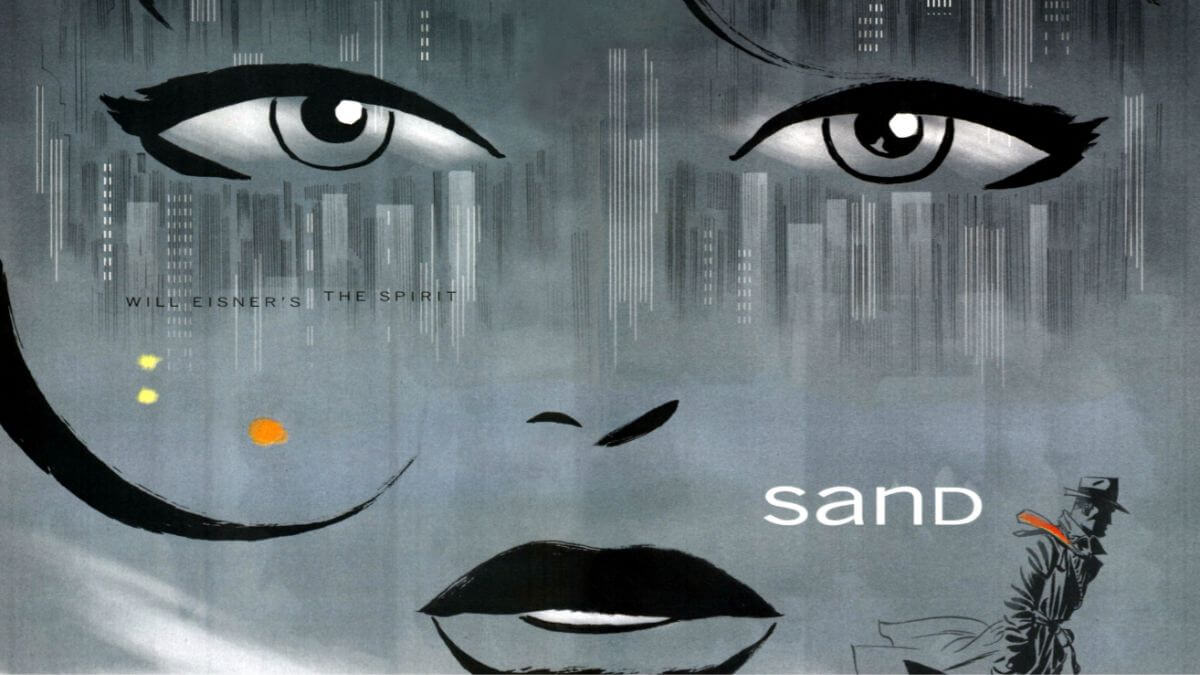
In this edition of The Full Run, we look over DC Comics‘ The Spirit #12, written and drawn by Darwyn Cooke, inked by J. Bone and coloured by Dave Stewart.
When it comes to debating what is truly the greatest story from Will Eisner’s time on The Spirit, there are many strong contenders. “Ten Minutes” is a fascinating character study of how quickly one’s life can unravel. “The Killer” puts the reader in the mind of a psychopath. My personal favorite, “Fox at Bay”, is a perfect blend of Eisner’s technical experimentation with efficient storytelling. But what none of these stories have is the emotional stakes (and overall availability) of the two part story around The Spirit’s childhood love, from the stories “Sand Sarif” and “Bring in Sand Sarif.” It even was poorly adapted into the much maligned Frank Miller film. Those stakes are recognized by Darwyn Cooke, who closes out his Spirit run with an adaptation of those stories that surpasses Eisner’s work to become the definitive take on this tale.
Cooke’s tale kicks off with the death of one of his recurring characters, which immediately ups the stakes. Seeing an original and likeable character be offed punches the reader right in the gut, while investing them in the story immediately. Is it a bit of a trope? Yes, especially in serialized fiction. But here, it’s executed so effectively that it’s only noticeable by miserable critics pouring over the details of the issue to spot an imperfection *wink wink*.
From there, the issue follows much of the same structure of Eisner’s original two-parter. Flashbacks peel back the history of star-crossed lovers Sand Serif and Denny Colt – now The Spirit – from their youth to their reunion at present. Rather than pour over the details of a nearly 20 year old story (or 80 year old in Eisner’s case), what can be said is that Cooke provides proof that retelling a classic story is worthwhile if in the hands of a creator with a vision. This is a story Cooke clearly wanted a crack at given the artistry behind it. Compare this with the gimmicky remakes of “The Case of the Chemical Syndicate”. Batman’s debut story has been retold at least 5 times – four times for anniversaries, including twice in the same issue (Detective Comics #627).
Cooke’s visuals are the true reason this issue is a stand-out. As great as his work was in the previous issues, he appears to have leveled up here. While there are moments of traditional sequential artwork present, much of the issue sees Cooke playing with panel structure and shadows for a unique, noir look. Moreover, Cooke is more interested in telling the story directly via his visuals, supplementing it with only necessary dialogue. It’s an approach that has been replicated many times over in modern comics, but often results in an issue that is rushed through and finished by a typical reader in under 5 minutes. But in Cooke’s hands, the artwork makes for an immersive experience, compelling the reader to slow down and ensure that each panel is studied before moving on to the next. This is in many ways a precursor to his phenomenal adaptations of Richard Stark’s Parker novels.
The Spirit #12 might very well be the finest single issue that Cooke has produced. It’s a tightly plotted, done-in-one story that serves as a vehicle for him to be bold with his artwork. Furthermore, it improves upon Eisner’s original work in every conceivable way. While Eisner used The Spirit as a vehicle to experiment with the comics medium, Cooke manages to do the same thing while also giving readers an emotionally resonant story. If there is one comic to explain why The Spirit is still a worthwhile character, it’s The Spirit #12. If there is one comic to demonstrate how to tell a great story in the span of a 20-page floppy, it’s The Spirit #12. And if there’s a single comic that reminds us how tragically short Darwyn Cooke’s life was, it’s The Spirit #12.