‘DIE Loaded: Zero Sessions’ Review — Kieron Gillen and Stephanie Hans’ Dark Fantasy Triumph
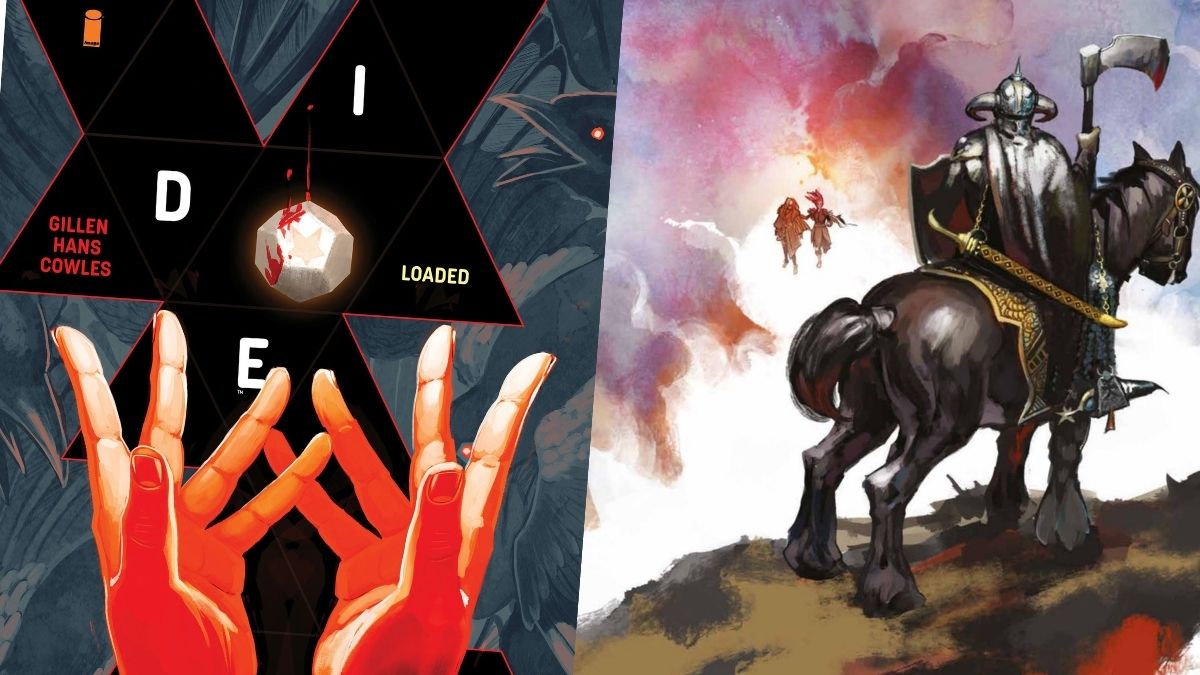
Nobody is a side character in DIE Loaded: Zero Sessions. Here’s our full spoiler review of Kirion Gillen and Stephanie Hans’s new installment in the hit series!
When I was looking through my inbox to email Ashley Hurst, the Editor-in-Chief of Comics Bulletin, about getting a review copy of Die Loaded’s first trade, I was reminded that he actually approached me to write a review of the first issue late last year. I struggled for a while to remember why I never responded to this email. It took until sitting down to write this article that the reason came back to me: I hadn’t actually read the first volume of DIE when Ashley sent the email. I only read it earlier this year, and I loved it. If I had read it sooner there would have been no chance I’d have passed up on the opportunity to talk about this newest installment of DIE by Kieron Gillen and Stephanie Hans.
So let’s properly start with the preliminaries:
“Is DIE Loaded worth reading?” Yes, absolutely.
“Should I read the first series before this one?” Not necessarily. It’ll add to your enjoyment of the book and its world, but you could get a complete experience from this volume alone. However, the first volume is beautiful and well worth your time.
“Ok, but what is DIE Loaded actually about?” Well, that’s harder to answer. But here is the long and short of it: Five friends return from a game world, known as Die, for the second time. Die is a fantasy realm where, as one character in this volume describes it, “real-world people … get dragged into a realm which takes people’s trauma and wishes and throws it back at them”. The first time the friends were sent and returned they were teenagers. For their second campaign they’re well into their 40s.On both horrible adventures they lose one member of their party to the game (these are the events of the original series). Now, they once again assemble for the memorial of their fallen friend thinking they’ve put Die behind them. They’re wrong, DIE isn’t done with its games just yet (here begins the events of this series).
To go into any more depth beyond this would be getting into the realm of spoilers. Which is exactly what I’m going to do. So go and read DIE Loaded: Zero Sessions if you haven’t. After the next little section about the art we are fully going to enter spoiler territory.
The Art
Before we go fully into spoiler town it seems prudent to give some focus to the relatively spoiler free topic of the art in this volume. Stephanie Hans’ art is as wonderful as ever. She takes all the desperate literary and game influences of Die and makes them sing into a cohesive whole. This article truly won’t go into the depths of analysis that Hans’ art deserves, since I will be dedicating the majority of the word count to narrative. But know that it’s watercolor/painted-esque look and range cannot be understated.
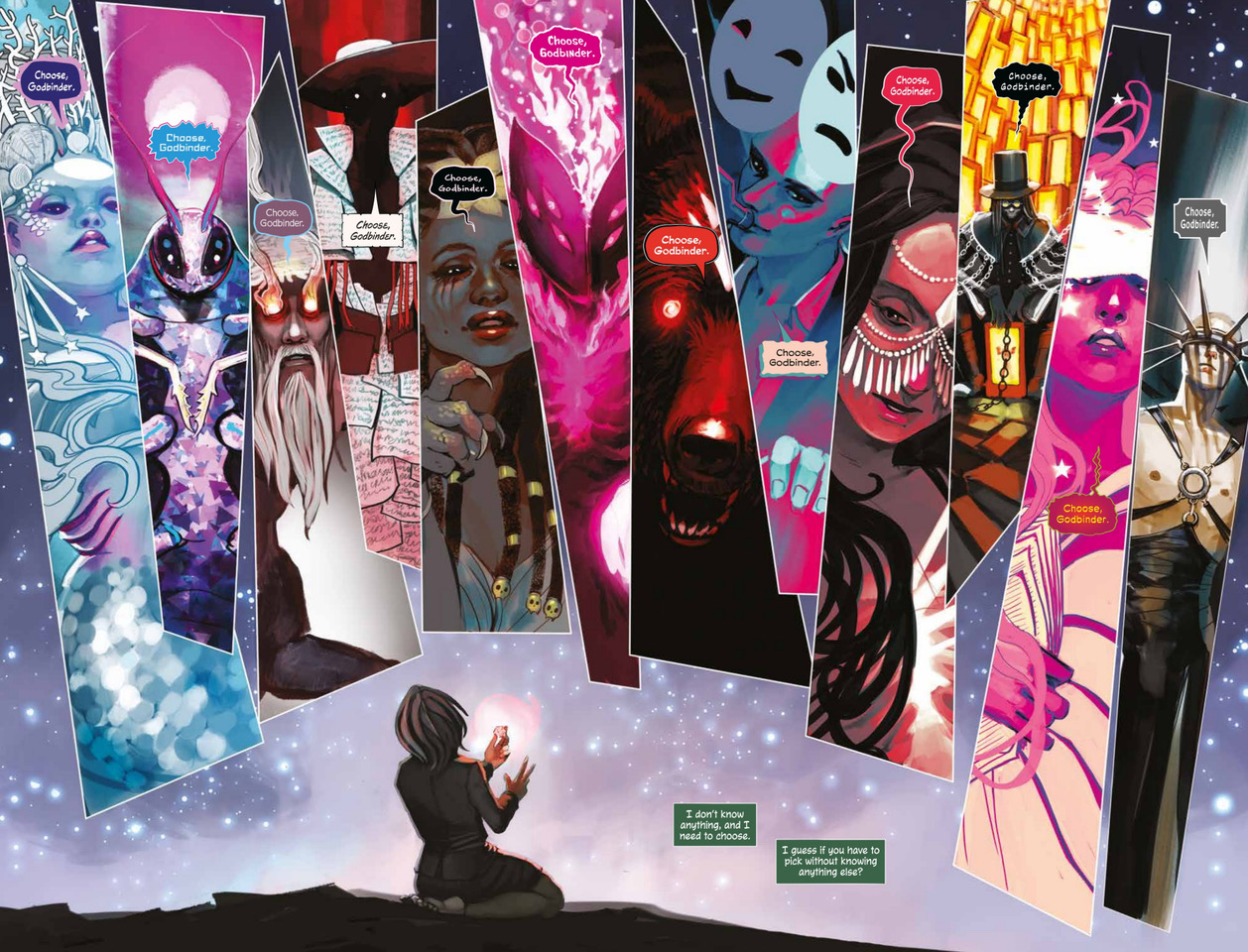
I want to give particular note to the designs of the gods of Die, both old and new. The Gods were always an interesting thread in the original series but one that we never fully got the time to explore as readers, since narrative priorities were elsewhere. If DIE Loaded has a secondary aim to its main thesis (one we’ll get into a little bit later), it would be to highlight and flesh out the gods of this realm. Sophie, our central character this time around, is a God binder and thus has a deeper relationship to the deities of Die than Ash, the protagonist of the original series, ever did. The task of giving unique life to all the god’s designs and making this pantheon feel varied is no small one, but Hans more than meets the challenge. The moments where we get to see the gods of Die in their full splendor are nothing short of extraordinary. A particular splash page from the first issue is especially of note. Hans plays with a wider range of colors in this splash than in any page before in the series (though it feels important to note that Hans is generally playing with more colors on any given page when compared to the original book). Yet the varied colors don’t harm the wholeness of the splash page, it all feels perfectly, precariously, balanced.
While my knowledge of the subject is woefully inadequate, it’s clear to anyone with even a cursory familiarity with the subject that Hans is pulling just as much from French comic art traditions as Anglo-sphere comic influences, if not even more so. None of which should come particularly as a surprise, Hans is a French artist after all. But this element of her art gives it a unique quality to most books you see published even from the likes of Image or other indie publishers. Hans is a pretty singular artist and her work is nothing short of extraordinary, both haunting and beautiful.
A Literary Comic
Now we fully enter the realm of spoilers, so beware from this point forward.
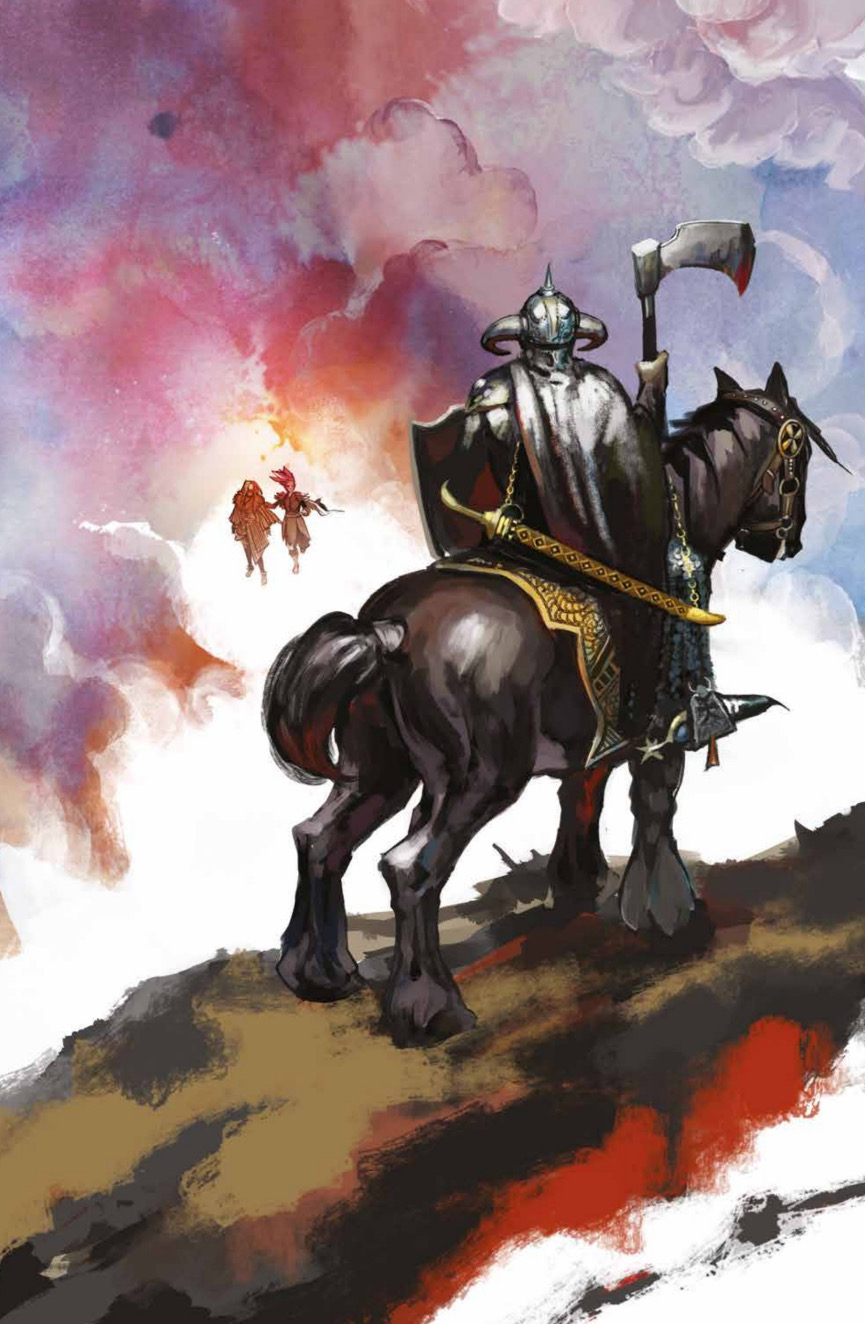
DIE Loaded is firmly a literary comic. That is to say that it engages with the literary influences for table top role playing games (ttrpgs), mainly but not exclusively from the fantasy genre. Die is a D20 shaped world with each side, or region, of the d20 reflecting one of those influences. Those lands each have a master, usually the progenerating author of the literary work that influenced ttrpgs. For example, The realm of five’s master/architect/metainfluence is Frank Frazetta, a notable fantasy artist. Frazetta’s influence and work is all over early ttrpgs. The issue that features his realm gets quite meta and uses Frazetta to make a broader point about art. The beautiful lie of the visual art that gets people interested in ttrpgs or games period. The ads that fill our heads up with worlds that exist only in our imagination. The deceptive falsehoods we are shown that lead us to the table, but that the table can never truly give us.
This volume’s other meta influences range all the way from Le Guin to fantasy precursors like the Arthurian legends, all in both a literal and figurative sense (the line between those two in Die is very thin). Yet it isn’t just purposeless name dropping and reference pandering. Each of the realms influences serve narrative purpose, propelling the story with added momentum and thinly veiled allusion. DIE is a series that wears its influences on its sleeve, yet doesn’t let itself become subservient to those influences.
The Cast
Like the initial series, DIE Loaded features a cast of beautifully realized characters, each of whom are messed up in their own myriad of ways. With their own flaws and necrosis played up in the game world, everything is on display. Broadly, this first arc of DIE Loaded is a “gathering the party” story. What that means, structurally, is that we meet one member of the party per issue as they assemble, giving each character a focus. The central character, as mentioned before, is Sophie. She’s the wife of the original series protagonist, Ash, and she’s the unreliable lens we see everyone else through. In fact, each of the members of the party this time around have some kind of familial connection to the party members from the previous volume. That actually gets at the central thesis of DIE Loaded: no one is a side character, tertiary characters are just unexplored characters. This is a thesis reflected by the various methods of play each character embodies and how they interact with the game and their fellow players.
Let’s start with a deep dive on Sophie, the aforementioned POV character of the book. While her significant other, Ash, was away in Die for the second time she, a woman in her early 40s, had a successful pregnancy by means of IVF, spending about a year as a single mother to her child Stuart before Ash returned from the game world. Another important fact to mention here is that the original party from the first series were all under a spell where they couldn’t talk about what really happened to them when they went missing into the game world of Die. So until arriving, nobody knows about Die outside of those who have escaped. Sophie is a bundle of anxiety, she’s insecure in her relationship with Ash and worries about Ash’s capacity to take care of Stuart while she’s trapped in the game world. For this reason she wants to make this stay in Die as short as possible. She’s the player who Die has the least to offer in terms of fantasy. Her fantasy is to escape.
Molly is the child of one of the original party members. Their relationship to their mother is strained because they resent her for the time she was away, not knowing the truth of her being trapped in Die. Molly finds themselves as a knight powered by their own rage in the world of Die. They’re angry and confused in all the ways that are typical of someone who’s just barely out of school. They frequently grasp at sociopolitical terms as a way to win arguments. For every time they correctly deploy one of those terms or concepts they are just as likely to say “bisexuality is transphobia” as a way to take a dig at their mother. Molly, like the entire cast, isn’t a one dimensional character in the book, they’re their own complex and fucked up person. To add an extra layer to the drama, in the original series we see Molly as a fallen, one of the shambling atemporal dead players of Die (Die is an atemporal cluster fuck, things that happen in the future can appear in the past). So knowing that Molly is on the proverbial chopping block, Sophie has to find ways to keep them away from the action and danger, playing a delicate game with their rage knight amplified ego. Molly mirrors a possible future where Stuart, Sophie’s child, might hold anger and resentment against Sophie if she’s separated from him for too long, just in the same way Molly was separated from their mom. Their in-game class plays into a power fantasy of games as an emotional outlet. Molly is angry and full of early adulthood rebellion, but due to the fate that awaits them they have to be literally benched, a player who’s prevented from playing.
Margaret is the mother of one of the original players, one who was trapped in Die for twenty plus years between the first and second adventures. Despite never giving up hope that he was still alive, she had to live for more than two decades in a world without her son. She’s full of regret and has an overwhelming sense of lost time. She serves as a possible, horrible, future Sophie might inhabit lest she spends too much time in the game world and never gets back to Stuart. In the real world she was a teacher, in-fact Molly was one of her students, in the game world her class is dictator. As a dictator, she can control people through commands, a teacher’s ultimate fantasy for unruly children. Her narrative function beyond this is to keep Molly on the sidelines by locking them down.
Chuck from the original series, while as complex and nuanced as the rest of the cast, was an asshole. It would be a tempting narrative pitfall to just shrug and say assholes beget assholes, but Gillen and Hans take a more nuanced route. Two of Chuck’s estranged children are in the game world, Callum and Violet. While they’re both people formed by their absent asshole of a father, they’re not him. Or in other words, they offer realistic portraits of what a shitty dad can do to a kid.
Callum is absolutely the worse of the two of them. He’s Chuck’s worst qualities bound up in a hormonal teenager with a serious case of main character syndrome. His player fantasy is one of max hedonism, fucking and killing to his hearts content. He’s the antithesis to the book’s thesis. He acts as if everyone else, especially women, are NPC’s or side characters in his story. This is compounded by the fact that his class is fool, a player class where your stupidest plans are often your most successful. For Sophie he reflects a horrible future of what Stuart might become if she doesn’t get back in time to ensure that he grows up to be a proper and empathetic young man.
Violet is maybe the hardest character for me to write about, she’s another one of Chuck’s children who has been sucked into the game world of Die. Difference is, she’s the one who orchestrated the campaign, by handing out magical dice that transport the players to Die during Chuck’s memorial. She’s the “why” of this book, the inciting incident. But as to her personal “why”? The reason she mastered this campaign into existence? For one of the most human of reasons, closure. She never got to have proper closure with Chuck. This part requires some explanation, fallen can come back to life by killing another player character. So Violet’s plan is thus: trap one of the other players and feed them to her father so she can have a conversation. Devious actions for such an understandable desire. Of course she lets the new fallen kill Chuck and come back to life after she gets her closure, but the damage is still done. She’s traumatized not just Sophie, the temporary sacrificial player, but the entire party, not to mention endangering their lives. The question at the heart of Violet’s character is this: how far would you go for closure?
Violet is the most relatable character for me. This bit requires me to get a bit personal. My dad wasn’t exactly a model father, in many ways he was a bad person and a bad father. He’s also dead. So do you see why I can relate to Violet? Dead father who wasn’t a very good person, wanting to talk to them one last time? The only difference is that I had a sense of closure with my father, a final moment that felt like the end of a book. Violet didn’t. Her motives are so understandable yet the depths of depravity she’s goes through to get what she wants is unconscionable, which is what makes her such a beautifully realized, fucked up character.
To finish out the cast we have Tommy, the dad of one of the original party members. He not only lived through the tragedy of losing his son to the game twice for years at a time, but he also lost his wife to a routine and mundane surgery. On top of that, he suffers from some cognitive decline in his old age. The fantasy that Die offers him is a life where his dead wife made it through the surgery, a do-over. There isn’t too much more to say about Tommy. He’s probably the least developed party member in this volume. Which, while a result of limited page space, is no mistake, Gillen has mentioned that he’ll get developed more as the series goes on.
That Ending
I’ve dedicated the bulk of this article to the characters in DIE loaded. I think that speaks to the sheer amount of weight the book gives to these characters. DIE Loaded: Zero Sessions is a character driven book, not a plot one. The plot itself is deceptively simple, sans the complicated world building of Die (most of which was established in the initial series). I’ve said it before but the heart of the series is the thesis that nobody is a side character, and that’s what makes the ending to this volume so effective.
I mentioned how Callum acts before, how he views people as playthings in a sandbox made only for his amusement. Well in the final issue, while Sophie is off collecting Tommy to complete the party, Callum goes full murder hobo and kills all the other members of the party in their sleep. He doesn’t want to return home. He never wanted to return home. He wants to continue his hedonistic rampage though Die. The extra layer to this is that the party members he kills are all people he perceives as women (Molly is AFAB non-binary but Callum doesn’t view them as their chosen identity). Callum is representative of a certain type of gamer. One that will be familiar to many of us that have felt excluded from the proverbial table. The privileged man who makes no space at the table for anyone other than himself or those like him. He’s a boys club of one, and these women (again, heavy caveat) have no place in his game, so they must die. I said it before, but he’s the antithesis to the book’s thesis made flesh. To kill someone is wrong chiefly because it is the ultimate act of denying a person their autonomy, Callum does it with reckless abandon.
In the Final Analysis…
This article has been a beast to write. To be a little bit too frank, I’m not sure that it coheres. It may be bloated and a mess and a disservice to the book it’s reviewing. But if nothing else, I think the three thousand words I spent on this review speaks to the depth of DIE Loaded: Zero Sessions. The sheer level of craft and care that has been put into this book. DIE Loaded: Zero Sessions is a thoughtful meditation on play and storytelling, through a vibrant and fully realized cast it paints a world where no one is a side character, no matter what the murder hobos might think.