Be Careful What You Wish For: Brandon Thomas on Subverting the Power of Fate in ‘Super Creepshow #3’
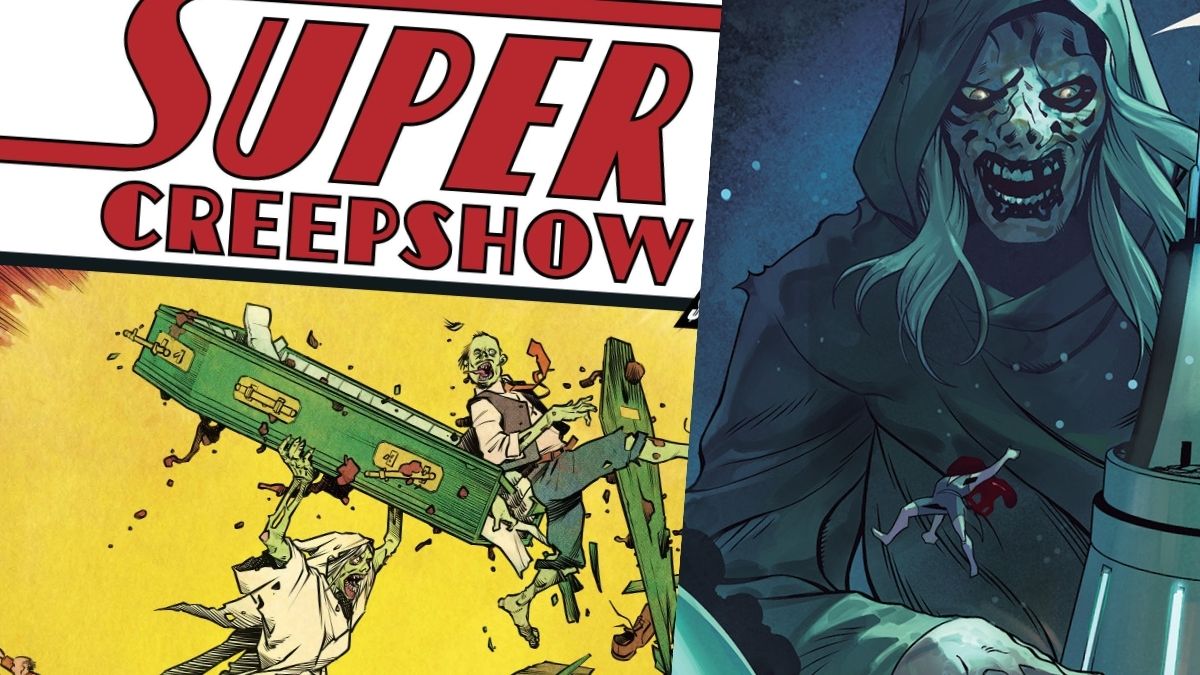
In Super Creepshow #3, Brandon Thomas delivers an icky (in a good way!) story about playing with fate.
Comic book scribe Brandon Thomas is no stranger to our website. In fact, he was a columnist for us back in the day when Comics Bulletin was known as Silver Bullet Comics. Since his Ambidextrous column on our site, he’s gone on to much bigger and better things, penning such titles as Excellence, Horizon and The Many Adventures of Miranda Mercury at Image Comics. He also notably spent significant time writing Aquaman stories at DC. His latest project was one of two stories in Super Creepshow #3, where he takes readers under the ocean for a his first-ever comic book horror story — and it’s excellent.
With the release of Super Creephow #3, we caught up with Thomas to discuss his story. It’s a pleasure to have his words back on our site. Let’s dive in.
Comics Bulletin: For readers who haven’t picked up Super Creepshow, tell us about your story, in your own words. What would your elevator pitch be?
Brandon Thomas: A superhero’s greatest villain finally stops playing games and comes after his hated nemesis in a way that defies all odds and good sense. Even though victory and survival looks and feels impossible, the valiant hero finds that one small weakness in just the nick of time and saves the day. Everybody lives, and the bad guy promises never ever to do it again.
Well, that’s what I wish happened anyway. What actually happens is far more interesting and disturbing than that, but I’d feel pretty bad if I completely spoiled it all here. Like many a Creepshow tale, there’s a brutal twist and moments of visual depravity that simply don’t belong in traditional superhero comics, which is why it’s included here, because that’s not what this series is all about. On top of all that, it’s the first actual horror story that I’ve written in comics, so I’m extremely excited for people to dive in and leave feeling all icky.
Your story is a cautionary tale about the dangers of playing with fate, and subverts the traditional view of ‘wishing’. What made you want to tackle these tropes within the Super Creepshow universe, and what was the inspiration behind the physical appearance and personality of The Wish?
BT: I feel like creative professionals spend a lot of time wishing for good things to happen, especially when we’re getting established. Wishing for better opportunities, wishing for the right creative partnerships that can change everything, etc., and you know, there’s that famous saying. So emotionally, I felt like I intimately understood that concept, and I wanted to subvert that and play with what happens when you think you got everything you wanted.
Our main character is really struggling with his own sense of self-deception, and ultimately blaming other people for choices that he made. Very dangerous emotional brew there, and physically The Wish is a character that looks like he should be responsible for ruining your life, but the person that’s really at fault is much closer to home. (Laughs) I’ve probably already said too much, but yeah, that’s what I was going for.
CB: The world-building in your story is extremely impressive for a short-form anthology piece. How did you approach building out such a fascinating and unique setting in such a short page count?
BT: Thank you, I appreciate that! The concept of time is something that I’m always obsessing over in my scripts, almost to the point where I have to actively stop myself from figuring out fun and efficient ways to shift through the story’s timeline, but in this case, it was absolutely necessary. The critical part for me is always centering the underlying emotions and themes, which help keep the characters and the readers anchored to what really matters, which let the time shifts become more window-dressing and incidental. They’re just a way to get to the feelings faster, if that makes sense.
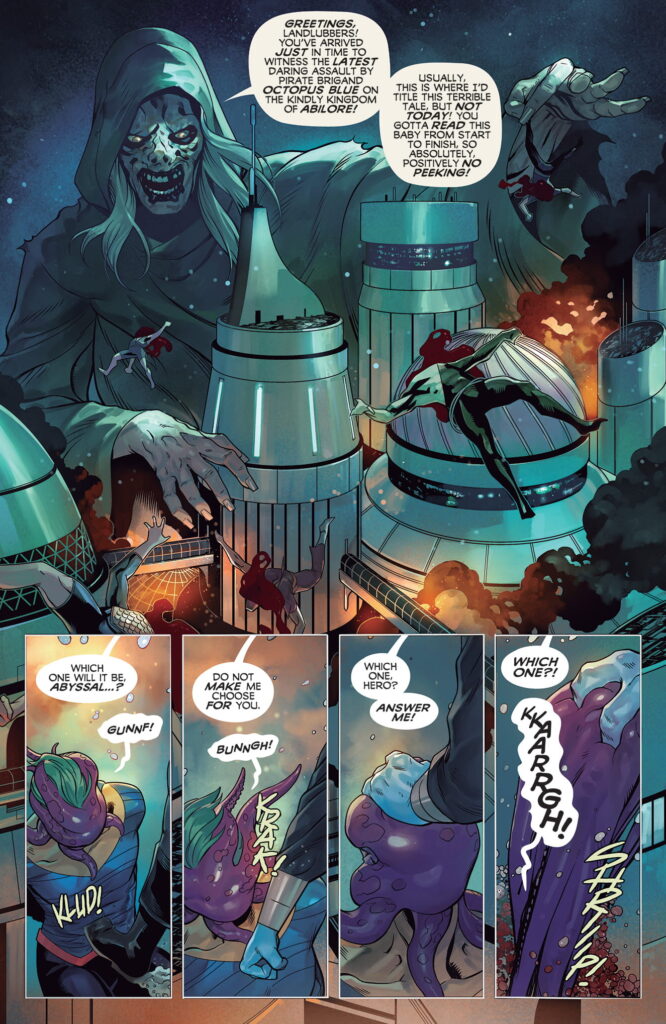
I wanted to portray a transformation in The Abyssal that will happen gradually, but also in the blink of an eye, which is often how unpleasant memories can feel when they overwhelm us.
CB: So far in this series, stories have used superhero archetypes as a starting point. For your story, what specific super influences, if any, did you look into or want to draw on?
BT: Well, since I spent several months writing Aquaman stories a few years back, that world and its basic framework was my most immediate influence. Once we get past those initial concepts though–the amphibian lineage, the underwater kingdom, it quickly becomes clear this is not anything at all like Aquaman. This hero is far more flawed than his counterpoint, and most importantly, the lengths his villains will go to in order to heap ruin and humiliation upon him far exceeds the safer and more confined attacks we’re used to. Killing the hero is simply not enough here, and if they’re not trying to systematically take everything away from you, what’s the point?
CB: Tell me about your collaboration with Juann Cabal. What did it look like?
BT: Like any great artist, Juann took this story and brought it to full life, which I know wasn’t an easy task. As you mentioned, there are a lot of jump cuts, time shifts, etc. all throughout, and if that’s not executed the right way, the reader could definitely get lost in everything, but Juann was able to preserve and bolster everything, and there’s some stunning, fantastic work all throughout. He especially shines once things take a darker and more violent tone, which is exactly what anyone wants from a Creepshow story. Extremely happy with the final product, and think everyone else will be too.
Super Creepshow #3 is out now from Skybound/Image Comics. The issue also includes a brilliantly creepified cosmic tale from James Harren.