Indigenous Magic & Colonial Boundaries: The Canadian Border in Marvel Comics
The Canada that exists in Marvel Comics is in many ways similar to the real Canada, and when it is not, it often mirrors reality. Pierre Trudeau has been prime minister, the Front de Libération du Québec (FLQ) have engaged in terrorism to advance their goals of a separate Québec, and there is a Canadian American oil company with a paramilitary arm to protect its financial interests. However, the way that Indigenous characters and magics interact with the Canadian border do not reflect any real relations with the border, but reify colonial understandings of it.
Indigenous sovereignty in Canada has been called into question since Canada’s colonial project began. The sovereignty of Indigenous nations in Canada can be thought of either as an inherent right, one that existed before the crown’s incursion into Canada and has continued to exist since, or a right that is contingent on the state of Canada codifying it. Whether you view Canada’s claim to authority over the land and people of ‘Canada’ to be more legitimate than the preexisting claims of the many nations that have inhabited the same land since time immemorial, it is true that Indigenous people of Canada have had certain rights conferred to them by the government of Canada (and the United States) that imply certain ways of interacting with the bodies politic surrounding them. These implications are ignored by Marvel comics in favour of naturalising the authority of Canada over Indigenous peoples.
In Alpha Flight #12, written by John Byrne, as soon as Narya/Snowbird/Anne Mackensie steps foot into the United States she begins to lose lifeforce. The comic contends that her relationship to the colonial nation that changed her name and gave her a job is so essential to her being that it is almost as if her body is trying to deport her. Narya’s magic, which is what seems to bind her to Canada, comes from her mother, a (fictional) Inuk goddess, and is impossible to separate from her identity as Inuk. A writer with basic knowledge of the rights of the Indigenous peoples of Canada would have recognised though, that any ‘Indians’ who can prove at least 50% blood quantum, including Inuit, can freely cross the border from Canada into the United States. The Jay Treaty has ensured that people who are Indigenous to what is now Canada have almost all the same rights in the United States as citizens, including a right to not be deported.
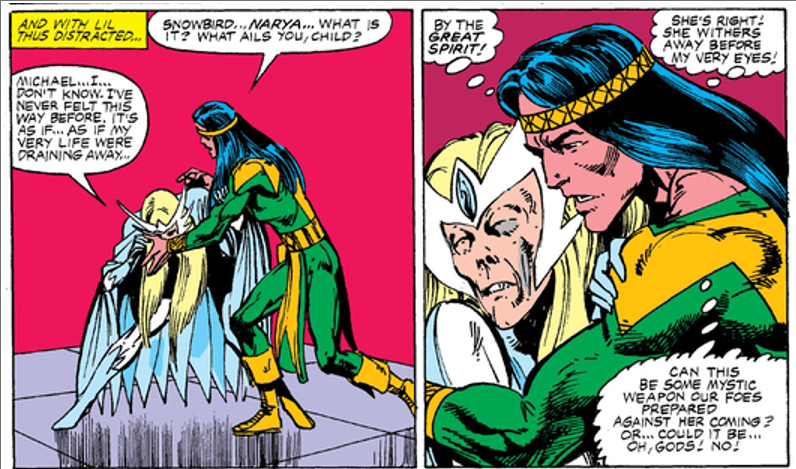
Why do these rights not extend to Narya? Surely the state that gave her her white identity was aware of her identity as Narya and her role in Department H’s Alpha flight. It could have been interesting if it was Anne Mackensie who could not cross the border, if the white identity that was created by the Canadian government so she could work for the Royal Canadian Mounted Police (an identity that would not only not exist but would have no meaning were it not for Canada), was restricted to Canada. Rather, the comic makes it clear that not only is Narya not allowed to cross the border, but that Indigenous magic is not allowed to, either.
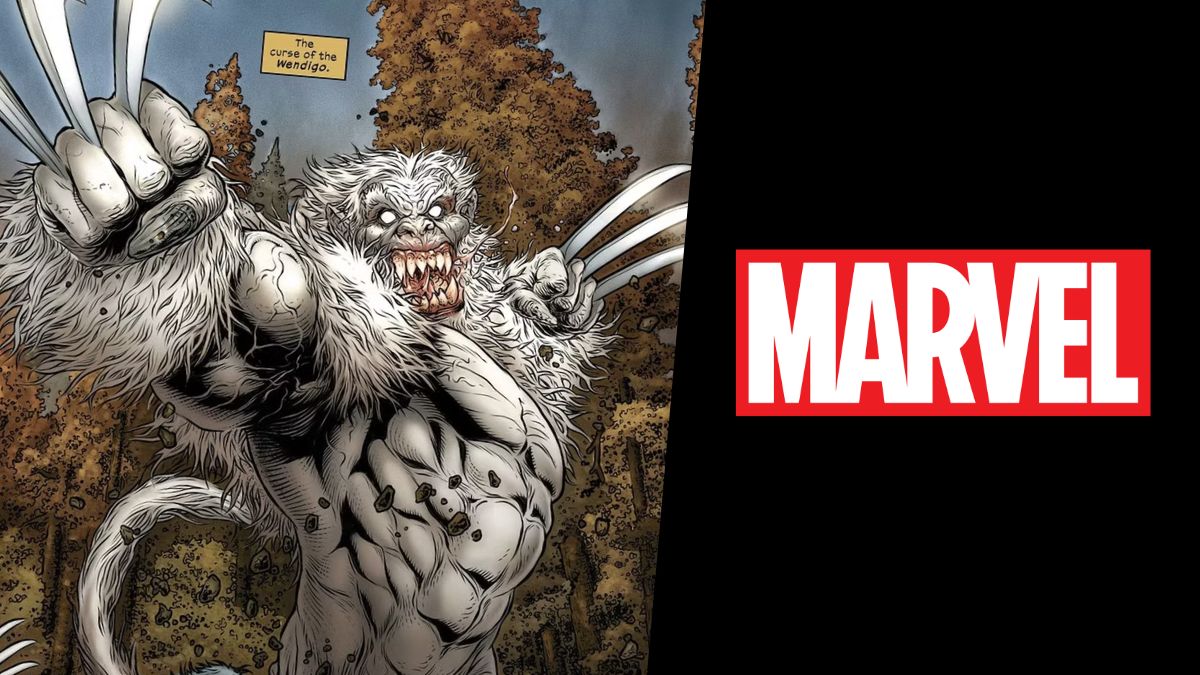
In 2014, in Amazing X-Men, wendigos start appearing in Canada after a murder in a meat processing factory. While it seems that the wendigos of Marvel comics are somewhat inspired by werewolves (in appearance and in that ‘the curse’ can spread through biting), the namesake of the wendigo is the Algonquian mythological creature that sometimes bears the same name, a cannibal with a never-ending hunger. In Amazing X-Men #9, Wolverine explains that a wendigo is created when a human eats another human’s flesh on Canadian soil. In the next few comics, wendigos crossing the border revert into human form, but Tanaraq (one of the ‘Great Beasts’, which I understand to be fictional Inuit deities) is revealed to be gaining strength with every new infection, throwing the spirit realm out of balance, and threatening the balance of earth as well. What is also explicitly threatened is the national security of both Canada and the United States, by a quickly diminishing citizenry and a huge wave of questionably legal immigration, respectively.
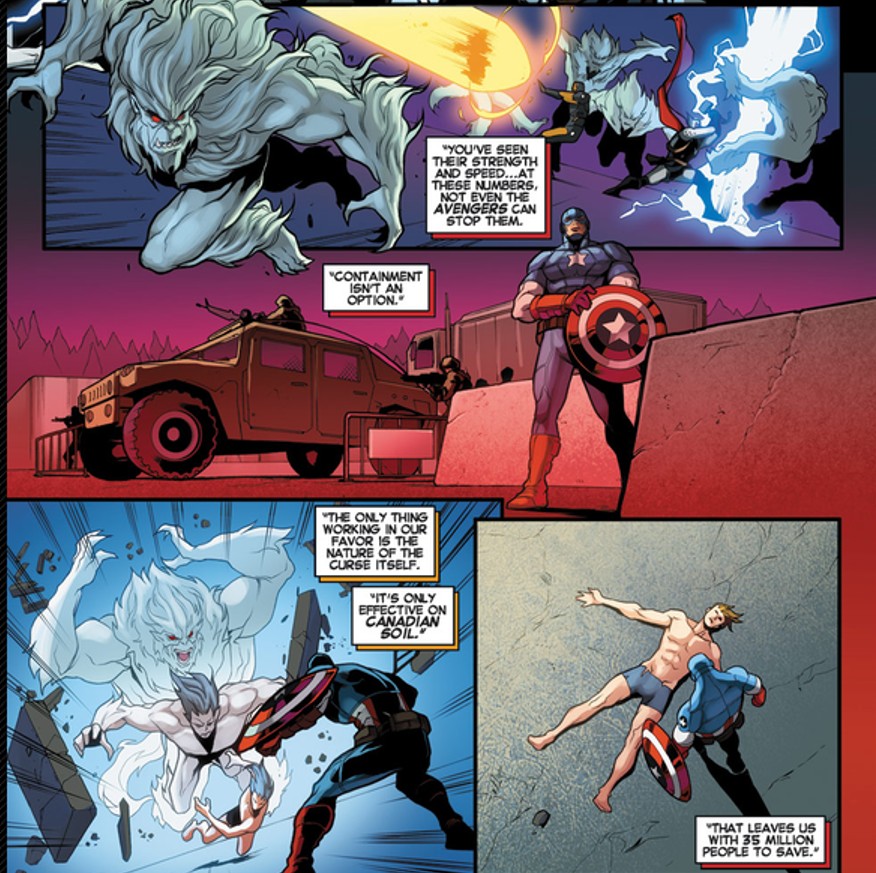
Historically, the Algonquian peoples’ homelands spanned what has now become the United States and Canada. The wendigo is not uniquely Canadian. But in the comics, the threat of Indigenous magic becoming strong enough to cross the border is a threat that the X-Men and Alpha Flight must fight. Of course, the wendigos of Marvel comics come with the threat of immeasurable violence, but presumably this threat existed before the border. There is an additional threat at play, that wendigos being able to cross the border calls into question the legitimacy of a sovereign Canada and United States.
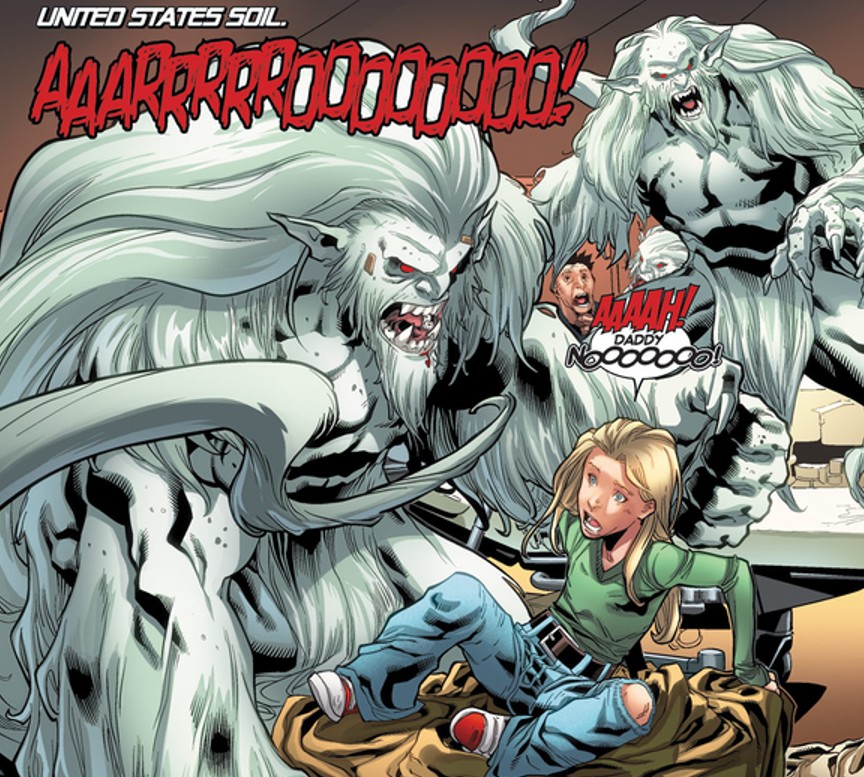
The way that the border is being depicted in these comics, as a boundary for magic Indigenous to Canada, naturalises the existence of Canada. It says that this magic is not just Indigenous to the land now referred to as Canada, but inherently and inextricably Canadian. It says that the Indigenous peoples of Canada have always been Canadian, and that to try to change that would cause either death of the Indigenous people or a national security threat. It denies a history of Indigenous people resisting the forcible label of Canadian, an arbitrary division at the 49th degree latitude. It denies what even law does not deny, the historical sovereignty of Indigenous peoples and the right of Indigenous Canadians to cross the border freely.
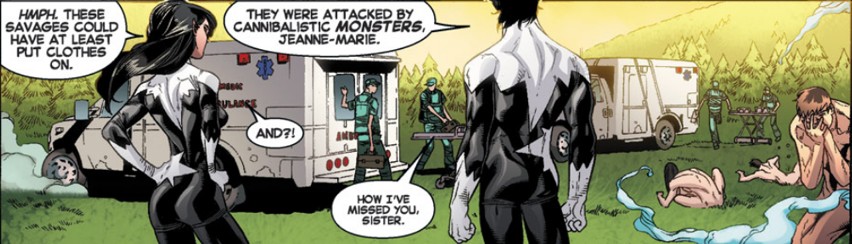
Political or super, Indigenous peoples’ powers have existed since time immemorial, and when popular fiction denies that power it has real life implications.