The Center Holds #1 Review: Accountability, Ideology, and the Cost of Heroism
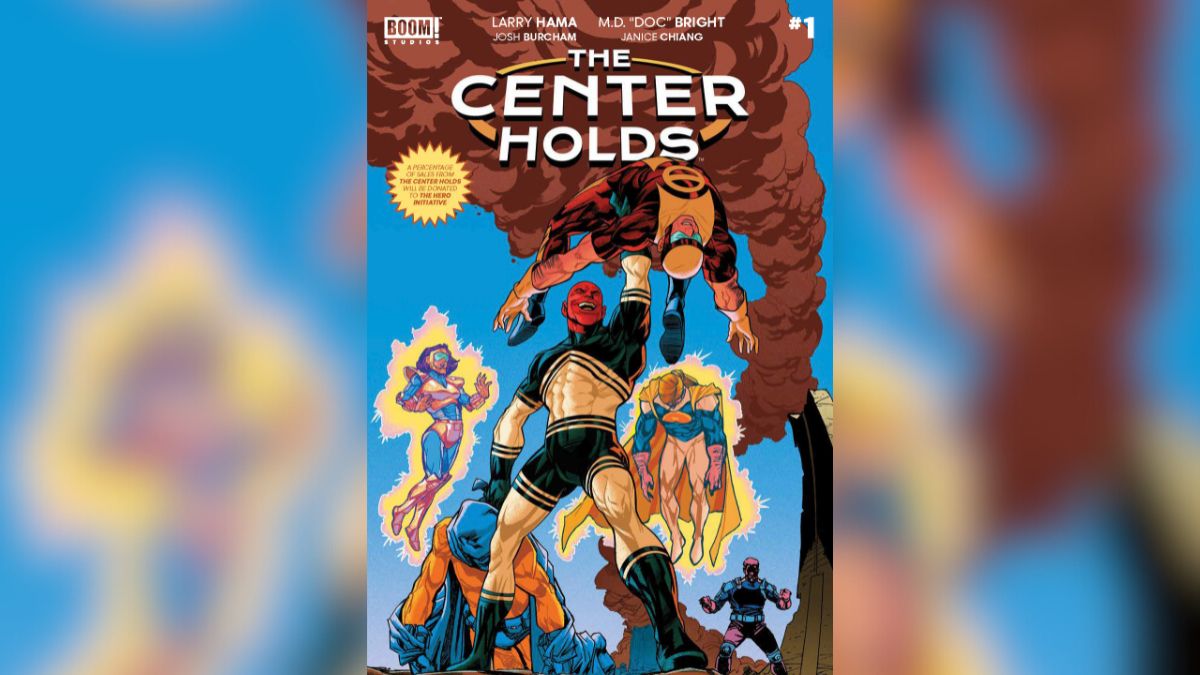
Legendary writer Larry Hama and the late M.D. “Doc” Bright present The Center Holds, a superhero series that questions the very nature of what it means to be a hero. Is it any good? Behold our review!
Larry Hama and the late M.D. “Doc” Bright’s The Center Holds #1 arrives carrying a great deal of weight before a page is even turned, not just as the launch of a new superhero universe, but as Bright’s final published work. That context matters, but it doesn’t smooth over the experience of reading the issue itself, which opens in an abrasive register, dropping the reader into an already-moving world with little handholding. The dialogue is heavy, the ideas arrive quickly, and the book initially feels more interested in asserting its themes than easing the reader into them. As the issue progresses, however, and the focus shifts toward quieter character interactions, that early friction begins to resolve. What emerges by the end is a comic that asks more of its reader than its pitch suggests, and, with patience, begins to justify that demand.
At its core, The Center Holds is built around a grounded, immediately legible idea: in a world where superheroes are no longer rare anomalies, accountability has become unavoidable. Heroes are unionised, damages are tracked, lawsuits are real, and collateral destruction carries financial consequences. It’s a premise that feels less like genre novelty and more like an inevitable evolution of the superhero world, one that treats power as something regulated rather than mythologised. From the outset, the book makes it clear this system isn’t window dressing. Liability, ownership, and responsibility are positioned as central tensions, not background detail.
Where the issue invites scrutiny is in how quickly some of those tensions appear to stabilise. The introduction of patents and union-controlled ownership offers an efficient solution to the financial strain placed on heroes, but it also risks feeling like narrative hand-waving if left unchallenged. Because the comic foregrounds these mechanics so deliberately, returning to them repeatedly in its opening chapters, it creates a clear expectation that they will continue to exert pressure. The idea itself is solid; the concern is not that it exists, but that it must continue to carry consequence. By placing accountability so centrally, The Center Holds promises long-term fallout, and that promise will only hold if the solutions it introduces are tested as rigorously as the problems that necessitated them.
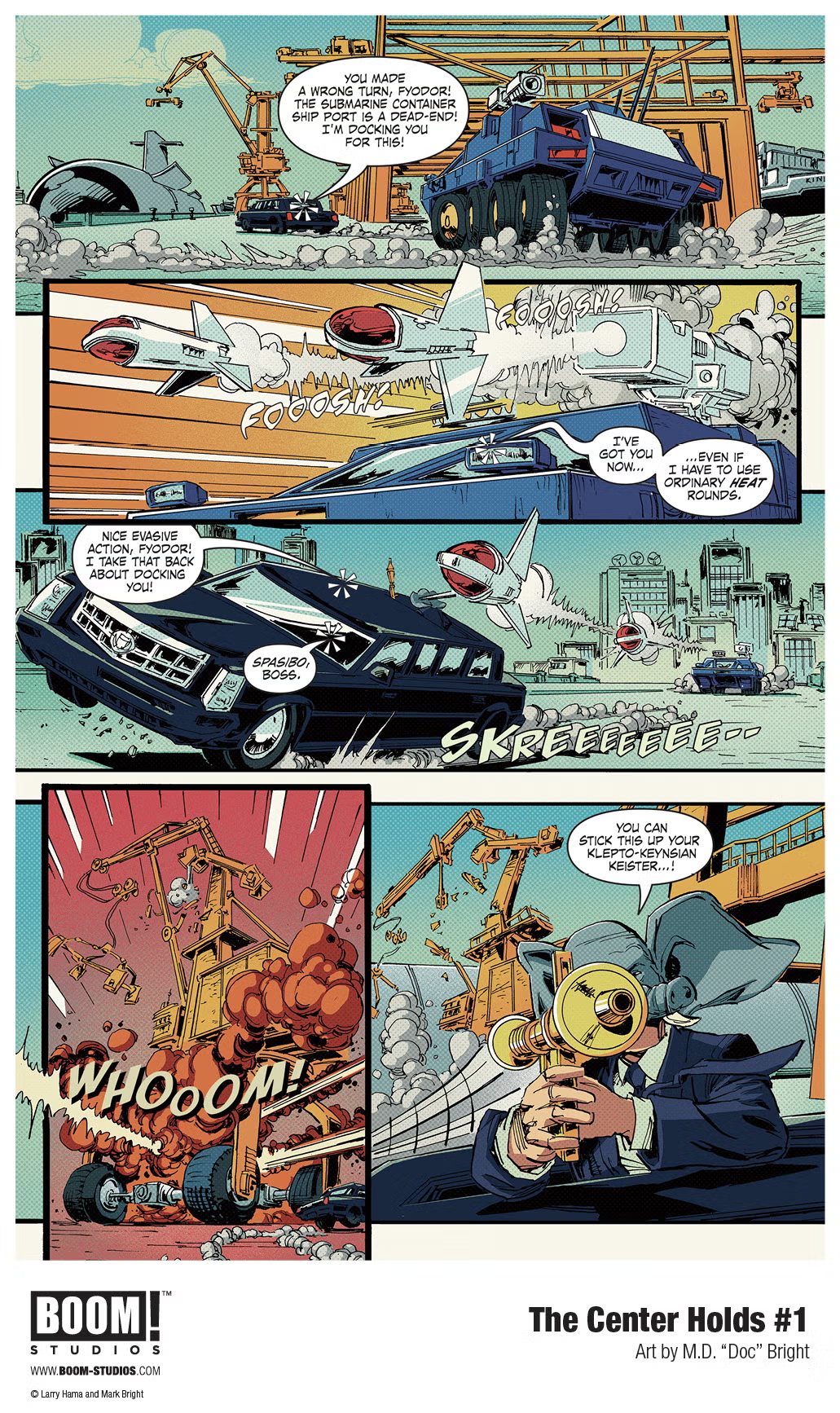
The most immediate point of resistance in The issue’s dialogue, particularly in the opening stretch. Conversations arrive dense with political language and rhetorical weight, often moving faster than the reader has time to settle into the scene. Characters speak in elevated, ideologically charged terms, sometimes beyond how people would naturally talk in the situations presented, and the effect can feel blunt rather than invitational. This is especially pronounced in the early pages and in the book’s use of Mr Right, whose speeches lean heavily on overt political phrasing. The result is an opening that feels less like a world being inhabited and more like a position being asserted.
That friction doesn’t read as accidental. There’s a clear sense that the book is deliberately front-loading its themes, ensuring its position is understood rather than inferred. Intention, however, doesn’t entirely soften impact. The speed and directness of the delivery make the early sections harder work than they need to be, occasionally pulling focus away from character and situation in favour of rhetoric. What’s telling is how sharply the book improves once it slows down. Later scenes, particularly quieter, one-to-one conversations, adopt a more grounded register, allowing character dynamics and shared history to surface naturally. In those moments, the same ideas land with far greater confidence. The contrast highlights both the ambition of the opening and the accessibility the series reveals when it trusts its characters to carry the weight.
Where the book truly finds its footing is in its character work, particularly once the story allows itself to slow down and focus on individual interactions. One-to-one conversations are where the writing is most assured, revealing characters far more layered than their initial presentations suggest. Rather than relying on exposition to define relationships, the book lets shared history surface through friction, familiarity, and restraint. The result is a cast that feels lived-in, giving the impression of a team that existed long before the reader arrived, without the need for constant explanation.
Scyber stands out as the clearest example of this approach working well. Her presence quietly interrogates questions of humanity, progress, and personal cost, not through speeches but through visual storytelling and small, telling beats. The physical markers of what she has lost, and what she has gained, give weight to the idea that heroism in this world is neither abstract nor consequence-free. A single panel communicates more about sacrifice and identity than pages of dialogue elsewhere in the issue. It’s in moments like these that The Center Holds is most assured, grounding its larger ideas in people rather than systems. When the book stops explaining its world and allows its characters to interact within it, the emotional core of the series comes sharply into focus.
Visually, the issue presents an aesthetic that is deliberately rougher and more traditional, favouring texture and clarity over contemporary slickness. The linework carries an older sensibility, one that may initially read as unpolished to readers accustomed to cleaner, hyper-detailed modern styles. That surface roughness, however, never translates into confusion. Panelling is consistently strong, particularly during action sequences, and the storytelling remains easy to follow throughout. Simple, broad colour palettes are used with intent, distinguishing scenes and moods without overwhelming them, and the issue’s visual confidence grows steadily as it progresses. By the latter half, the art settles into a rhythm that complements the story rather than competing with it. This is less about technical flash and more about functional, expressive storytelling that supports the book’s themes without getting in the way.
By the time the issue reaches its final pages, the earlier density has given way to a clearer sense of direction. The framing of the containment centre recontextualises what has come before, shifting it from a functional backdrop into a site of ideological tension, and introducing opposition that feels organic rather than artificially imposed. Crucially, the impulse to continue reading comes not from unresolved mechanics, but from the characters themselves. Their relationships, unspoken histories, and lingering conflicts provide the momentum the issue needs. While the broader world has yet to fully earn its emotional weight, that absence feels appropriate at this stage. As an opening chapter, the issue closes not by tying everything together, but by inviting the reader to stay and see what pressure does to the system it has begun to assemble.
The Center Holds #1 doesn’t arrive fully formed. Its opening is rougher than it needs to be, weighed down by dense dialogue and an eagerness to state its themes plainly rather than let them surface naturally. But patience is rewarded. As the issue progresses, the focus shifts away from rhetoric and structure toward people, their histories, their compromises, and the costs they carry, and the book becomes far more compelling as a result. By the final pages, the initial clunkiness has given way to genuine interest, not in the mechanics of the world, but in the characters navigating it. The Center Holds takes time to settle into itself, but once it does, it reveals a series more interested in humanity than spectacle, and that’s a strong foundation to build on.
Writer: Larry Hama
Artist: M.D. “Doc” Bright
Publisher: BOOM! Studios
Release Date: February 11, 2026