Absolute Batman: Ark-M #1 Review: The Cost of Safety in Gotham
The Weight of Arkham. Here’s our review of Absolute Batman: Ark-M #1 written by Scott Snyder and Frank Tieri with art by Joshua Hixson.
Absolute Batman: Ark-M #1 grounds itself in memory rather than momentum. Before it turns to containment facilities, emerging threats, or even Batman in action, the issue reaches backward, re-examining the long shadow cast by Arkham itself. This is not nostalgia, nor a simple retelling of familiar history, but an indictment, a reminder that Gotham’s most infamous institution was born from grief, fear, and the belief that suffering could be managed if it were understood deeply enough. Batman looms over this world not as a solution, but as a constant presence, his shadow stretching across a city that has learned to respond to trauma by building systems around it.
What Ark-M represents, then, is not escalation but intent. Where Arkham, as it existed before, failed through fragility and denial, Ark-M exists as a deliberate answer to that failure, an uncomfortable assertion that some problems cannot be rehabilitated, only contained. From its opening pages, the comic makes clear that this is not a conventional superhero story concerned with victory or justice, but an examination of how institutions evolve when fear is allowed to harden into policy, and what is quietly lost in the process.
Inheritance, Not Progress
The issue unfolds with measured patience, spending its early pages in the past before orienting the reader in the present. Rather than rushing through Arkham’s history as exposition, the narrative lingers on formative moments, allowing trauma and ideology to take root. These scenes are framed not as distant mythology but as lived experience, asking the reader to engage with the emotional logic that shaped Arkham’s founding and its eventual failure.
When the story shifts forward, it does so without reassurance. The transition from Arkham to Ark-M is not presented as progress so much as continuation, an uneasy evolution rather than a clean break. The past is not left behind. It hangs over the present, unresolved, shaping the new institution through absence as much as intention. Structurally, the book resists closure, positioning Ark-M as something built in response to failure, but never fully free of the same impulses that doomed its predecessor.
The Cost of Safety
At its heart, the comic is concerned with the moral cost of systems built in the name of safety. It repeatedly returns to the idea that institutions rarely begin with cruelty, but with necessity, shaped by fear and justified through reason. Arkham’s origins are framed as an attempt to understand suffering, yet that attempt collapses under the weight of its own contradictions, leaving behind a legacy that treats instability and violence as problems to be managed rather than confronted.
This unease deepens as the narrative deliberately blurs the boundary between mental illness and criminal violence, refusing clear categories or moral certainty. Patients, inmates, and perpetrators occupy the same spaces and are governed by the same logic. Batman’s absence across much of this timeline becomes quietly significant. Before he exists as a symbol or response, the city has already chosen how it will deal with fear, through containment, control, and the gradual erosion of empathy. By the time Ark-M emerges, it feels less like an invention than an inheritance.
Unease by Design
The artwork throughout the issue functions as psychological framing rather than spectacle. Its rough, uneven textures feel deliberate and period-appropriate, grounding the story in unease rather than polish. The pages resist visual comfort, lingering on faces caught in moments of shock, fear, or resignation, allowing emotion to surface without exaggeration. Violence and trauma feel intimate and unavoidable, not distant or theatrical.
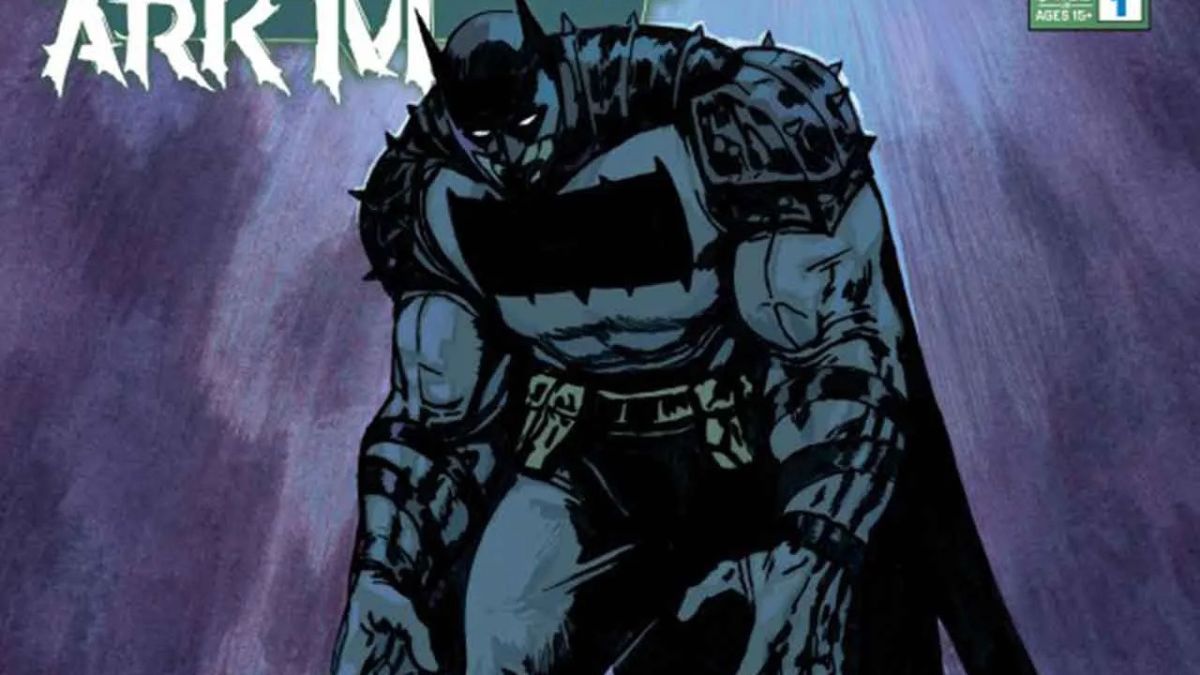
When Batman does appear, he is rendered less as a figure of motion and more as a force of scale and weight. His presence dominates through framing rather than action, heavy against the city that surrounds him. Mood does the work of atmosphere, with shadow and silence carrying more weight than colour ever could. The result is a visual language built on restraint, implication, and pressure.
What Arkham Creates
The emotional weight of the story rests on the relationship between Amadeus Arkham and Jack, not as opposing figures but as products of the same environment. Amadeus is framed less as a visionary undone by madness than as a cautionary example of conviction left unchecked. His belief that understanding could contain suffering is sincere, even compassionate, but the issue reveals how that belief narrows over time, hardening into something rigid and exclusionary.
Jack, by contrast, is not positioned as an aberration so much as an adaptation. Shaped by Arkham’s logic, he learns how to navigate and exploit the system that claims to restrain him. Rather than a singular mastermind, he becomes evidence of what happens when fear and control replace care. Batman appears only briefly and late, his presence serving less as intervention than as reminder. By the time he enters the narrative, Gotham’s patterns of response are already set.
Defining This Gotham
The book is structured so that prior familiarity with the Absolute Batman line is unnecessary. Rather than relying on ongoing plot threads, it positions itself as a point of orientation, using history and atmosphere to establish the moral landscape it inhabits. New readers are given enough context to understand the stakes without navigating continuity.
At the same time, the issue functions as a thematic cornerstone for the Absolute line. Ark-M is introduced not as a background location, but as a defining response to Gotham’s accumulated failures, shaping how threat, responsibility, and control are understood. Batman’s presence reframes these systems rather than disrupting them, clarifying the rules by which this version of Gotham has chosen to survive.
A City That Has Decided
By its final pages, the issue makes clear that it is less interested in shock than implication. What lingers is not a single act of violence or revelation, but the sense of a city that has learned to organise its fear into systems and call that progress. Gotham is no longer on the brink of collapse. It has adapted, embedding trauma into policy, architecture, and routine. Ark-M does not emerge as an aberration, but as the city’s most honest expression.
What the book ultimately accomplishes is a reframing of Gotham’s moral foundation. By tracing a line from Arkham’s origins to Ark-M’s existence, it exposes how easily care becomes control, and how quickly empathy erodes when safety is treated as absolute. Batman’s shadow still looms over the city, but it no longer reassures. Instead, it underscores a harder truth. Long before a vigilante arrived to challenge Gotham’s criminals, the city had already decided what it was willing to sacrifice in order to feel secure.